Blog Pricing & offers
How to Handle Offers on Antiques and Vintage: Take It, Counter, or Hold?
Whether the mall calls or an offer pings your phone: what sellers say, and what millions of real negotiations show.
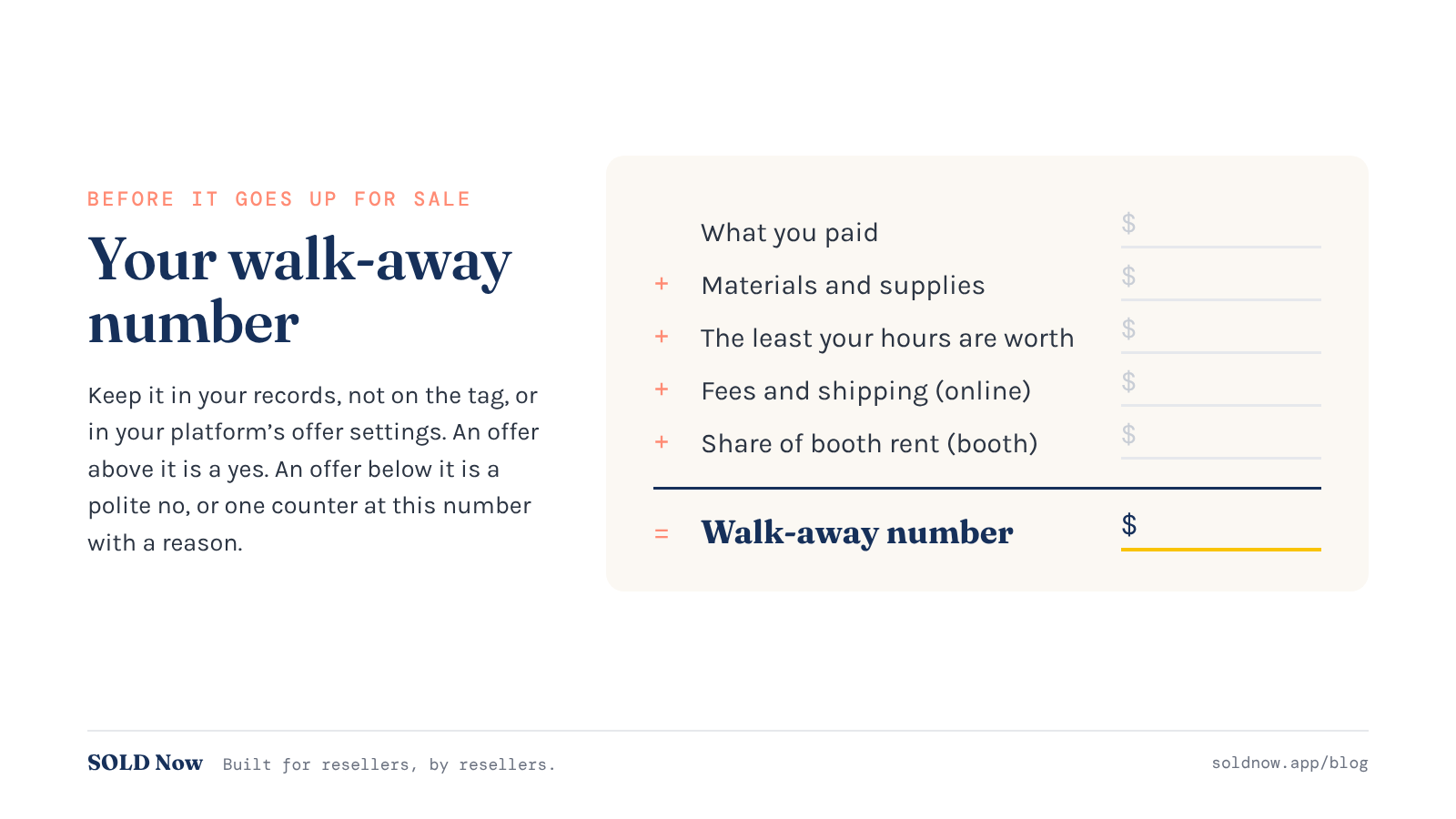
Decide your walk-away number before a piece goes on the floor or goes live online. When an offer comes in above it, taking it is usually the right call, especially on a big piece that has been sitting. Online, add fees and shipping to that number, and let your platform's offer settings hold the line for you. If you counter, counter once, with a specific number and a real reason, and know going in that many offers end without a sale no matter what you say.
That's the short answer. The longer one came out of a conversation we watched in a reseller group recently. It started with a booth, but the research that answers it comes from millions of online offers, so it applies wherever you sell. Some of the group's wisdom holds up, and some of it doesn't.
Where did this question come from?
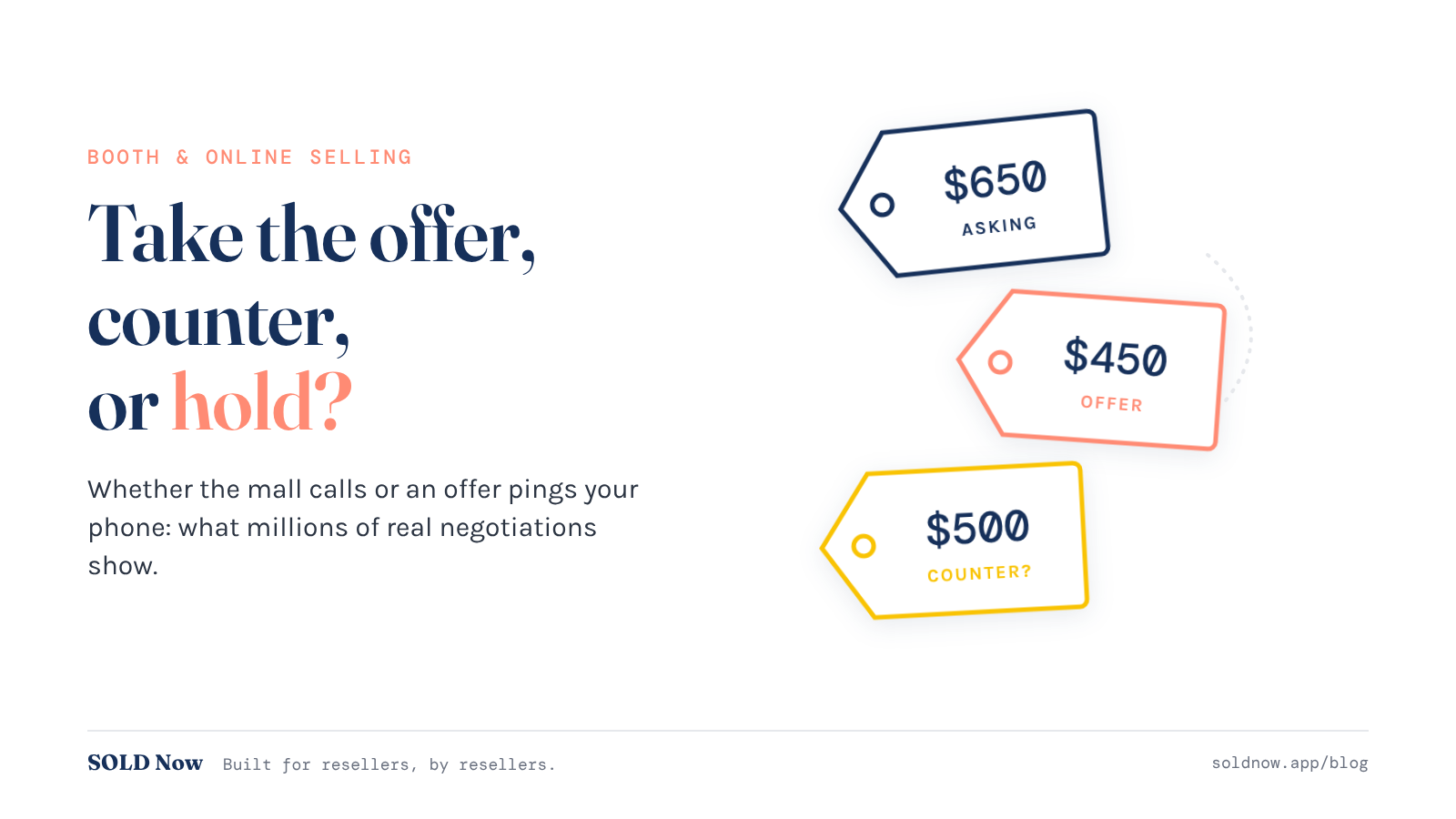
A dealer restored a matched pair of Victorian drop-front dressers. It was her first furniture restoration, so there was plenty of trial and error and a lot of materials. She priced them at $325 each, $650 for the pair.
The mall called with an offer of $450 for both. She had paid $200 for the pair, so that was $250 over what she paid, before materials. She countered at $500, figuring $50 wouldn't make or break the sale. The buyer walked, and the dressers didn't sell. The same thing had happened before with a pair of large chalkware figures.
Her question to the group: should she just take any offer that's above water, or is there a way to be fair to herself without losing the sale?
About twenty dealers and shoppers answered, and they didn't agree.
What did other sellers say?
The answers fell into a few camps.
Keep it moving. Several dealers said to keep inventory turning; as one put it, fast nickels beat slow dimes. If an offer makes money, take it, free up the space and bring in something new, especially when the piece is bigger than a breadbox. One said that once something has sat a long time, a lowball is welcome. Another draws the line by how the offer arrives: haggle in person, but when the mall calls, take the bird in the hand.
It depends on how long it's been there. A fresh piece holds its price. A piece that has sat for months is open to offers, just not one at 40 to 50% of the tag.
Hold a firm price. One dealer said counters lose the sale in most situations and a firm price is fine. Another avoids the question entirely: her mall only allows discount requests on items $50 and up, and never on a tag that already shows a markdown, so she prices low, marks down on the tag, and rarely gets the call. One dealer doesn't take offers at all.
Always negotiate. Others price with room to haggle and see it as part of the antique shopping experience, the way buying a car is. They worry that shutting down every offer leaves a shopper thinking less of the booth and the whole mall. One said a good deal brings the customer back to the booth.
The other side of that. One furniture dealer said the people who ask for discounts are not the ones who come back, and once turned down an offer at 38% of the price, then sold the piece at full price within hours. Another dealer has said yes to offers and still watched the buyer walk away. And one pointed out that the dresser buyer could have countered the counter; plenty of buyers never do. That seller also sells on Facebook Marketplace, where, in that seller's experience, buyers haggle hard and then disappear.
What buyers said. Two shoppers spoke up. One said an offer means they like the piece, but not enough to pay full price, and walking away after a no is fine. A glass collector said it isn't only dealers who ask: when a price looks high, they ask. If the seller comes back at least halfway, they'll consider it, while also checking the next booth and what eBay costs with shipping.
One firm framework. A furniture restoration business had the most detailed answer. Its take: the counter wasn't the mistake, the size was. Set a walk-away number on paper before listing (purchase price, materials and the least your hours are worth), counter once with a number that means something and a reason attached, then stop. It also said meeting in the middle is what loses most offers.
That last answer is the one where the research gets interesting.
What does research say about counteroffers?
Some of the best real-world data on haggling comes from eBay's Best Offer button, where a buyer makes an offer and the seller accepts, counters or declines. Economists from Columbia, Stanford, Berkeley and eBay studied more than 25 million of those negotiations (Backus, Blake, Larsen and Tadelis (PDF, opens in a new tab), published in the Quarterly Journal of Economics in 2020).
A few findings matter whether you sell in a booth or online:
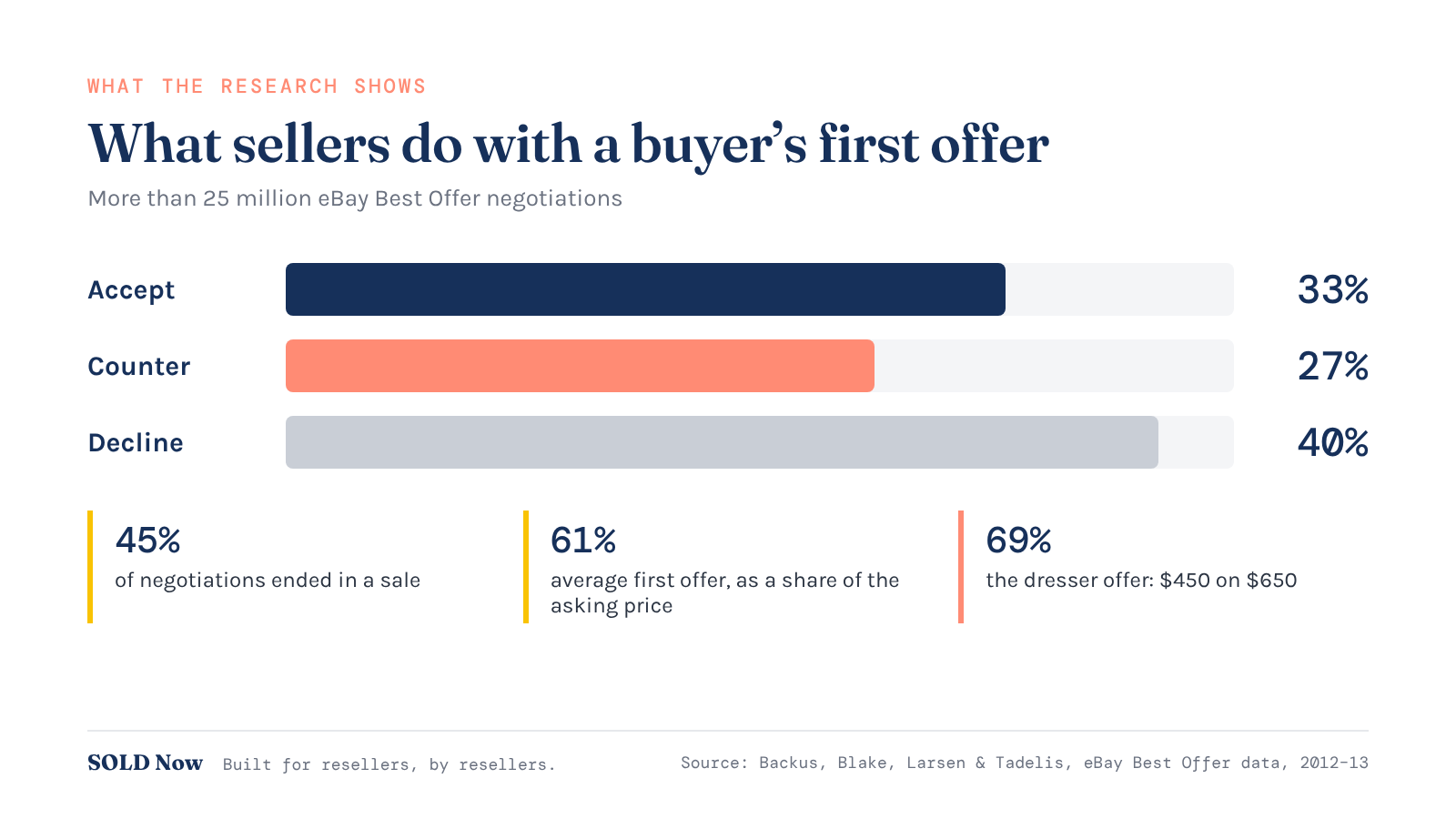
- Most negotiations don't end in a sale. Only 45% of them did. A negotiation ending with no deal was the more common outcome, not proof you did it wrong.
- Sellers say yes more than you'd think. Faced with a buyer's first offer, sellers accepted 33% of the time, countered 27% and declined 40%.
- The average first offer was 61% of the asking price. The dresser offer, $450 on $650, was 69%. By that measure it was a serious offer, not a lowball.
Does meeting in the middle lose sales?
The data says the opposite. The researchers found that an offer sitting halfway between the last two offers was 5 to 10 percentage points more likely to be accepted than other offers, even offers that were slightly better for the person accepting. People respond to a counter that feels fair, not only to the dollar amount.
So the claim that meeting in the middle loses most offers doesn't hold up. Splitting the difference was the single most common first counter sellers made on eBay, and one of the most successful.
Was the dresser counter too small?
Run the numbers and the $500 counter wasn't a small nudge at all.
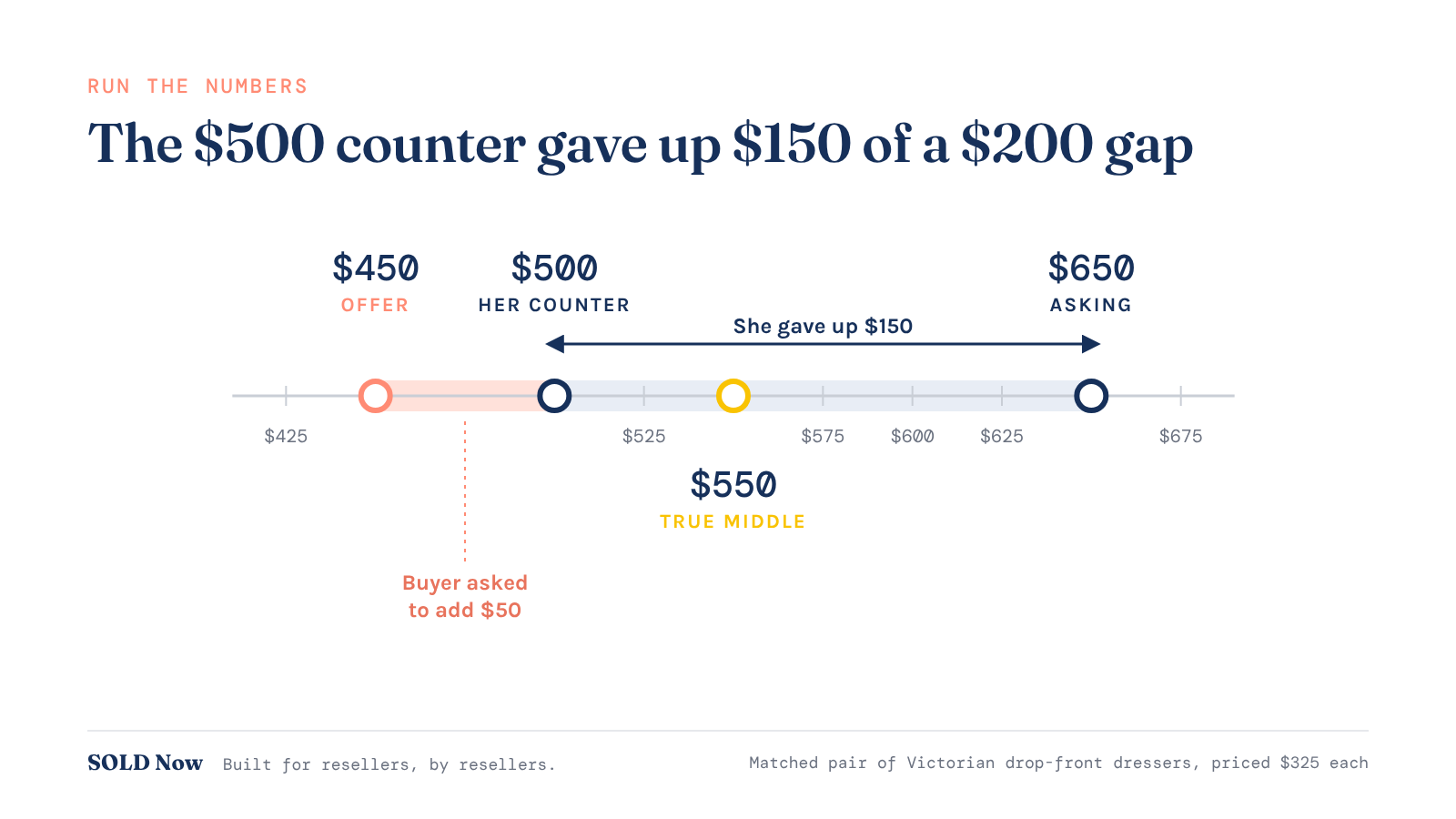
The gap between $650 and $450 was $200. Countering at $500 gave up $150 of it and asked the buyer to come up $50. The true middle would have been $550. She didn't guard the last $50; she conceded three-quarters of the gap in one move.
That matters, because the same eBay study found that negotiations that end with the seller saying no tend to be ones where the seller barely budged. She budged a lot. The likelier explanation is one the commenters pointed to: $450 was the buyer's ceiling, the buyer was another dealer with a resale margin to protect, or the buyer liked the pieces but wasn't invested. No counter would have changed that.
Where the restoration business is right is on two other points.
Know your walk-away number first. Negotiation teaching at Harvard's Program on Negotiation (opens in a new tab) starts there: before talks begin, work out the least you'll accept, and take any offer above it. Without that number, every phone call from the mall becomes a judgment call made on the spot.
Give a real reason. In a classic 1978 Harvard study (opens in a new tab), researchers asked to cut in line at a copy machine. With no reason, 60% of people let them; with a reason, 93 to 94% did. When the favor was bigger, only a real reason worked. And when eBay Germany started letting buyers and sellers attach a message to an offer (opens in a new tab), bargaining breakdowns fell 14%. “They were restored as a matched set” is a real reason. “I put a lot into these” is a reason the buyer doesn't share.
Should you counter with a round number?
Probably not, if you want to hold your price. A second eBay study by the same team (opens in a new tab) found that items listed at round hundreds ($100, $200, $500) drew lower offers and sold for 5 to 8% less than items at nearby precise prices. The trade-off: they got offers 6 to 11 days sooner and were 3 to 5% more likely to sell. A round number reads as “I'm flexible.”
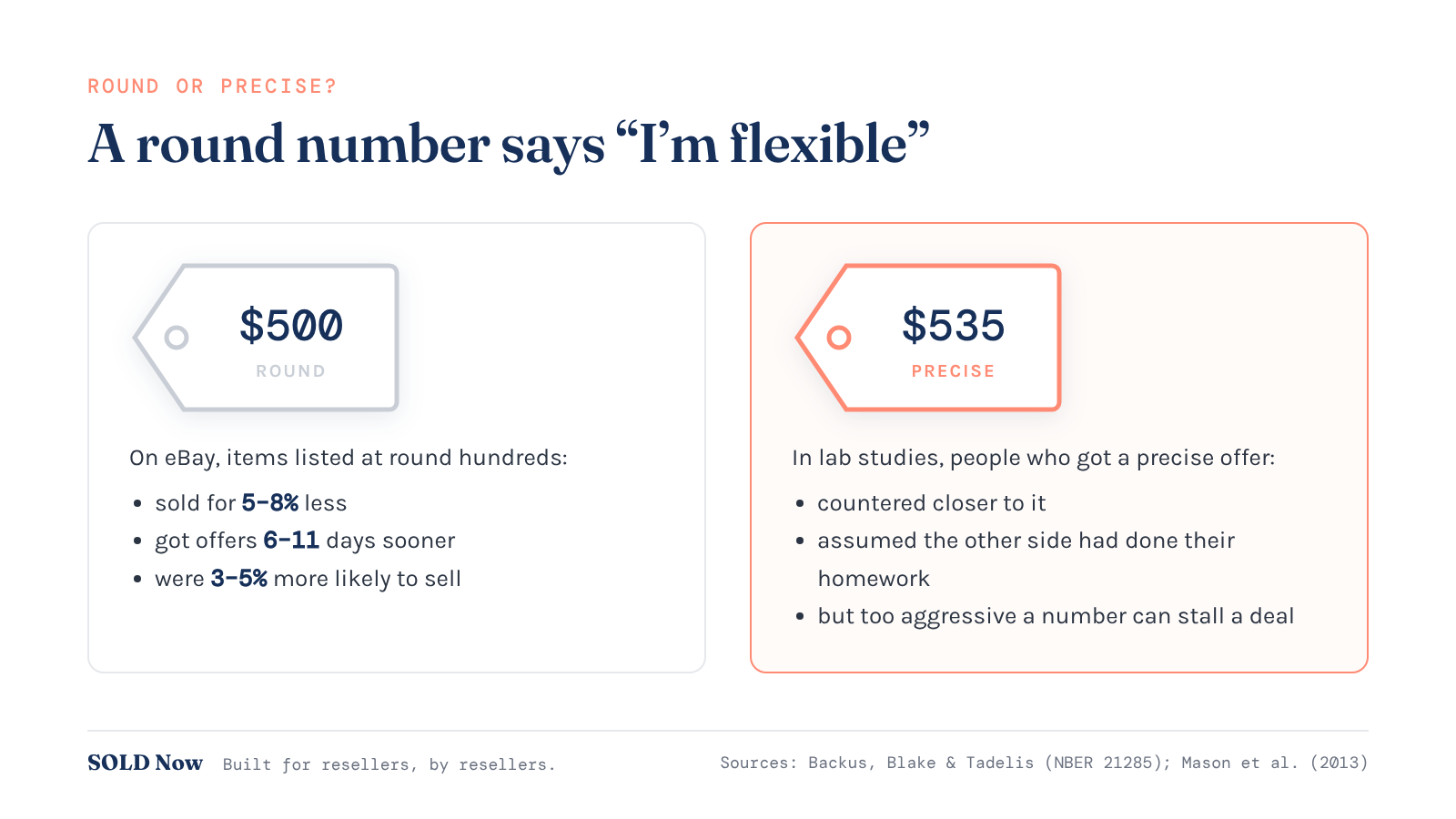
Lab research points the same way. Columbia researchers (opens in a new tab) found that people who receive a precise first offer counter closer to it, because a precise number looks like the other side did their homework. They also warn that a precise number that's too aggressive can stall the deal.
So a $500 counter quietly said “there's more room.” A counter like $535, because the pair matches and was restored as a set, says “I figured this out.” Treat that as a nudge, not a magic number: the research is from eBay and lab studies, not mall phone calls.
Does it matter how long a piece has been for sale?
Yes, and the dealers who said “it depends” are on solid ground. In the eBay data, patient buyers paid less, and sellers who signaled they wanted a quick sale sold sooner at lower prices. Time is part of the price. A dresser that has held its corner of the booth for months has been costing rent the whole time, and an online listing that sits keeps tying up money you could spend sourcing.
What you put into a piece is a different matter. Psychologists Hal Arkes and Catherine Blumer showed in 1985 that once people have invested money or effort, they keep going to avoid feeling wasteful, even when it no longer makes sense (the sunk cost effect (opens in a new tab)). Your materials and hours are real, and they belong in your walk-away number. They don't change what a buyer will pay. The glass collector in the thread said it plainly: if a piece sits for a couple of months with no interest, the price may be the problem.
What changes when the offer comes in online?
The thinking is the same. The math and the tools are different.
Your walk-away number goes up. Online, you keep less of the sale. Platform fees, payment processing, shipping and packing all come out of it, so a $450 offer online isn't the same money as $450 at the mall register. Add those costs before you decide what you'll take. Our post on hidden fees for resellers walks through the ones that change this holiday season.
Let the platform hold the line. Most resale sites and apps have an offer button now, and the rules differ in ways that matter:
| Platform | Your floor | Time limits | When an offer is accepted |
|---|---|---|---|
| eBay | Automatic accept at or above an upper limit and automatic decline below a lower limit; buyers can't see either | You have 24 hours to respond; your counteroffer stays open 96 hours | The item stays available to other buyers until it's paid for |
| Etsy | A maximum discount you set; buyers can't offer below it. USD shops only, and not in the Etsy Seller app | The help center lists no expiry on offers; after you send a final price, the buyer has 48 hours | The buyer isn't obligated to buy, and the item isn't reserved |
| Whatnot | The help center lists no floor setting | Unanswered offers expire after 30 days; a buyer has 24 hours to answer your counter | The buyer's card is charged right away |
| Mercari | Buyers can't offer below 75% of your price (bundle offers aside); the sellers' offer page lists no other floor setting | You have 24 hours to accept, decline or counter; a buyer has 24 hours to answer your counter | Binding; the buyer is charged immediately |
| Poshmark | Smart Sell sends, counters and accepts offers for you, down to a minimum price you set | Offers expire after 24 hours with no response | Binding; payment is processed and the sale is complete |
| Vinted | Buyers can offer up to 40% below your price | The help center lists no response window | Not binding; the buyer still has to tap Buy now, and someone else can buy it first |
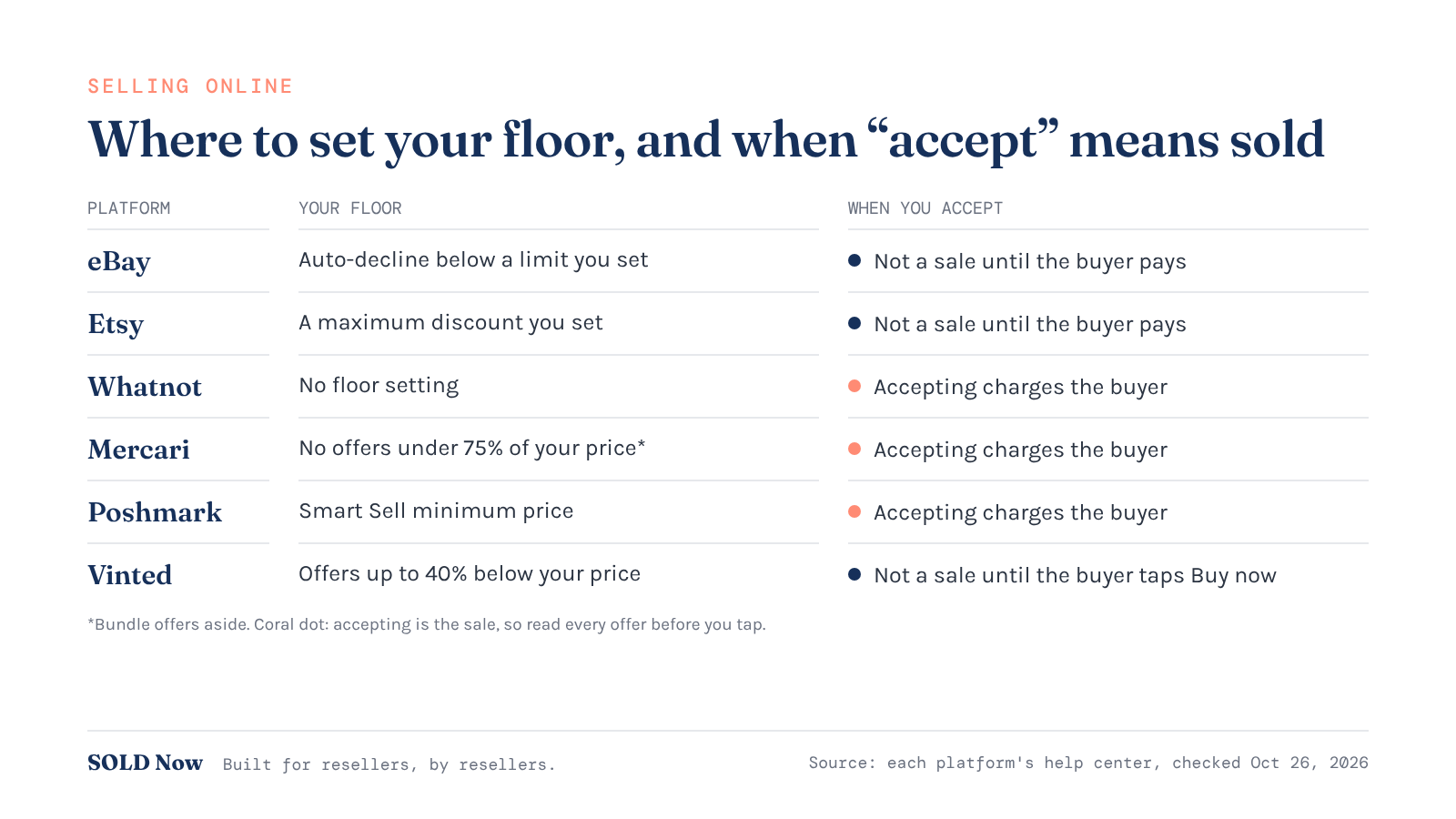
Put your walk-away number into whatever floor the platform gives you: eBay's automatic decline, Poshmark's Smart Sell minimum price, or Etsy's maximum discount set so nothing comes in below it. Mercari already blocks offers below 75% of your price, and if you'd rather not negotiate there at all, its help center suggests saying the price is firm in your description. On Whatnot, Mercari and Poshmark, accepting an offer is the sale, so read every one before you tap.
Several platforms also let you send an offer to people who already showed interest. eBay sends it to up to 30 of the most recent shoppers who watched the item or put it in their cart. Mercari's Offer to Likers needs a price drop of at least 10%, goes to up to 50 of the most recent likers and stays open for 24 hours. Mercari can also send your most recent Offer to Likers to anyone who likes the item later, after a delay you choose (Profile, then Promotion settings, then Offer to likers), or you can turn that off. Poshmark's Offer to Likers has to be at least 10% below the current price for a liker's first offer, and after that at least 10% below the lowest offer that liker has had in the last 90 days; it also lasts 24 hours. That's a tidy way to move a piece that's getting looks but no buyers.
One caution on Vinted: its US help center (opens in a new tab) says members can't sell as a business or with the goal of making a profit, and that Vinted Pro isn't currently available. If reselling is your business, read those rules before you list there. And on Mercari, if a sale would put you over the 1099-K reporting threshold and you haven't submitted a verified W-9, you can't accept or counter offers until you do; if you don't within the 24-hour offer window, the offer expires.
The research is from online selling. The 25 million negotiations and the round-number findings above all come from eBay listings, so they fit an online listing even more directly than a booth tag. A listing price like $195 or $295 tends to hold better than $200 or $300, though round prices sold sooner.
Buyers can compare in seconds. The glass collector in the thread checks the next booth, then eBay with shipping added. Online, any buyer can do that in seconds before making an offer. A one-of-a-kind piece, like a pair of dressers restored as a set, has fewer easy comparisons, which is a good reason to hold a firmer number on it.
An accepted offer isn't always a sale yet. One dealer in the thread has said yes and still watched the buyer walk. On eBay, Etsy and Vinted, a piece stays available until the buyer pays, so don't pull it from your booth or your other listings until the money is in. On Whatnot, Mercari and Poshmark, accepting charges the buyer, so treat the accept button there as the sale.
Who actually asks for a discount?
Both kinds of shoppers in the thread exist. In a Consumer Reports survey (opens in a new tab) of about 2,000 Americans, 48% had tried bargaining in the previous three years, and 35% said they won't bargain, period. Collectibles and antiques were among the categories where hagglers had the most success, and people who haggled over them saved about $100 on average. That survey is from 2013, so take the exact numbers as a snapshot.
Nashville antiques dealer Debbie Mathews LeRoy, interviewed by Better Homes & Gardens, put a common range on it: most antique stores will consider 10 to 20% off, and an offer 50% or more below the tag can come across as insulting. The dresser offer was about 31% off, past the usual range but nowhere near insulting.
Whether discount askers become repeat customers, we couldn't find a study that settles it. The dealers in the thread split on it, and both sides were describing real customers.
A simple routine for handling offers
- Before it goes on the floor or goes live, write down your walk-away number. Add what you paid, your materials and the least your hours are worth. For a booth, add a share of rent for the time you expect it to sit; online, add fees and shipping. Keep it private, or put it into your platform's offer floor.
- When an offer comes in, ask three questions. Is it above my walk-away? How long has the piece been here, and how much space is it taking? Could this buyer find the same thing two booths over or in a quick search online?
- If you counter, counter once. Pick a specific number (the middle is fine), attach one real reason the mall can repeat or the buyer can read, and be ready to let it go.
- Write down what happened. The offer, your answer and how long the piece had been for sale. After a few months, you'll see your own pattern instead of guessing.
| The situation | The usual move |
|---|---|
| Offer is above your walk-away, and the piece has sat for months or takes up real space | Take it |
| Offer is above your walk-away, and the piece is new to the floor or just listed | Taking it is fine. If you'd rather hold out, counter once, near the middle, with a reason |
| Offer is below your walk-away | Decline kindly, or counter at your walk-away with a reason, then let it go |
| The buyer counters your counter | You're negotiating; splitting the difference again is the counter the research favors |
| The same lowball keeps coming in online | Put your walk-away number into the platform's floor: eBay's automatic decline, Poshmark's Smart Sell minimum price, or Etsy's maximum discount |
None of this works if your walk-away number lives in your head and your costs live on receipts in a shoebox. Knowing what you paid, what you spent on materials and when a piece went into the booth or went live is what turns a phone call from the mall, or an offer notification, into a quick yes or no. Our post on what to do when antique booth sales slow down covers reading those numbers in a quiet stretch, and Are Antique Malls Going Away? shows how to see which pieces are paying the rent.
This is the kind of record SOLD Now keeps. Inventory on the Gold plan keeps each piece's cost, its location and your business expenses in one place, with reports and profit dashboards, so the walk-away number is something you look up instead of reconstruct. If you sell the same piece in a booth and online, Gold also cross-lists to eBay, Etsy, Whatnot and Facebook (Whatnot and Facebook by manual import), and it ends the eBay and Etsy listings on its own when a piece sells somewhere else and is out of stock. Gold is $39.99 a month, and every paid plan starts with a 30-day free trial. See the booth inventory tools.
The quotable answer: Set a walk-away number before a piece goes on the floor or goes live, and take offers above it, especially on large or long-sitting pieces. Online, include fees and shipping in that number. If you counter, counter once, near the middle, with a specific number and a real reason. Research on more than 25 million eBay negotiations found that only 45% end in a sale and that split-the-difference counters are accepted more often than other offers.
Frequently Asked Questions
Should I accept a lowball offer on an antique?
Accept it if it's above the walk-away number you set before the piece went on the floor, especially if the piece is large or has sat for months. If it's below that number, decline kindly or counter once at your number with a reason.
How much do antique dealers usually come down on price?
An antiques dealer interviewed by Better Homes & Gardens said most antique stores will consider 10 to 20% off. In a study of more than 25 million eBay Best Offer negotiations across all categories, bargained sales averaged about 73% of the listed price.
Does meeting in the middle work when countering an offer?
Yes. In eBay's Best Offer data, counters that split the difference between the last two offers were 5 to 10 percentage points more likely to be accepted than other counters.
Should I explain my price when I counter?
Yes, if the reason is real. A short, specific reason (“they were restored as a matched set”) gives the buyer something to say yes to. When eBay Germany let buyers and sellers attach messages to offers, bargaining breakdowns fell 14%.
Should I counter with a round number?
A precise number tends to hold better. Items listed at round hundreds on eBay sold for 5 to 8% less than items at nearby precise prices, though they sold sooner.
How do I stop lowball offers online?
Use the platform's floor. On eBay, turn on automatic responses and set the lower limit at your walk-away number; offers below it are declined for you, and buyers can't see the limit. On Etsy's Make an Offer, set the maximum discount so a $650 piece you'd let go for $520 never gets an offer below $520. Poshmark's Smart Sell works from a minimum price you set, and Mercari doesn't allow offers below 75% of your price, except on bundles.
Built for resellers, by resellers.
Sources
Platform help pages checked October 26, 2026. Rules change, so check the link before you lean on it.
- Backus, Blake, Larsen and Tadelis, “Sequential Bargaining in the Field: Evidence from Millions of Online Bargaining Interactions,” Quarterly Journal of Economics (2020); figures from the March 2018 working paper (PDF, opens in a new tab)
- Backus, Blake and Tadelis, “Cheap Talk, Round Numbers, and the Economics of Negotiation,” NBER Working Paper 21285 (2015) (opens in a new tab)
- Backus, Blake, Pettus and Tadelis, “Communication and Bargaining Breakdown: An Empirical Analysis,” NBER Working Paper 27984 (2020) (opens in a new tab)
- Mason, Lee, Wiley and Ames, “Precise Offers Are Potent Anchors,” Journal of Experimental Social Psychology (2013), via ScienceDaily (opens in a new tab)
- Langer, Blank and Chanowitz (1978), summarized in Psychology Today (opens in a new tab)
- Arkes and Blumer, “The Psychology of Sunk Cost” (1985), via BehavioralEconomics.com (opens in a new tab)
- Program on Negotiation at Harvard Law School, BATNA and reservation value (opens in a new tab)
- Consumer Reports, haggling survey press release, July 10, 2013 (opens in a new tab)
- Better Homes & Gardens, “5 Things You Should Never Do at Antique Stores,” interview with Debbie Mathews LeRoy
- eBay Help, Adding Best Offer to your listing and sending offers to buyers (opens in a new tab)
- eBay Help, Making a Best Offer (opens in a new tab)
- Etsy Help, How to Use the Make an Offer Tool (opens in a new tab)
- Whatnot Help, Enable and respond to Buy It Now offers (opens in a new tab)
- Whatnot Help, Make an offer on a Buy Now product (opens in a new tab)
- Mercari Help, How does Offer work for buyers? (opens in a new tab)
- Mercari Help, How does Offer work for sellers? (opens in a new tab)
- Mercari Help, How does the Promote button work? (opens in a new tab)
- Poshmark Support, What is Make an Offer? (opens in a new tab)
- Poshmark Support, What is Offer to Likers? (opens in a new tab)
- Vinted Help, Making an offer (suggesting a different price) (opens in a new tab)
- Vinted Help, Commercial selling (opens in a new tab)