Blog Booth selling
How Much Do Antique Booth Owners Make? What 60 Dealers Said
Some booths clear $1,400 a month; others barely cover rent. What 60 dealers reported, the break-even math, and how the $1,000 booths work.

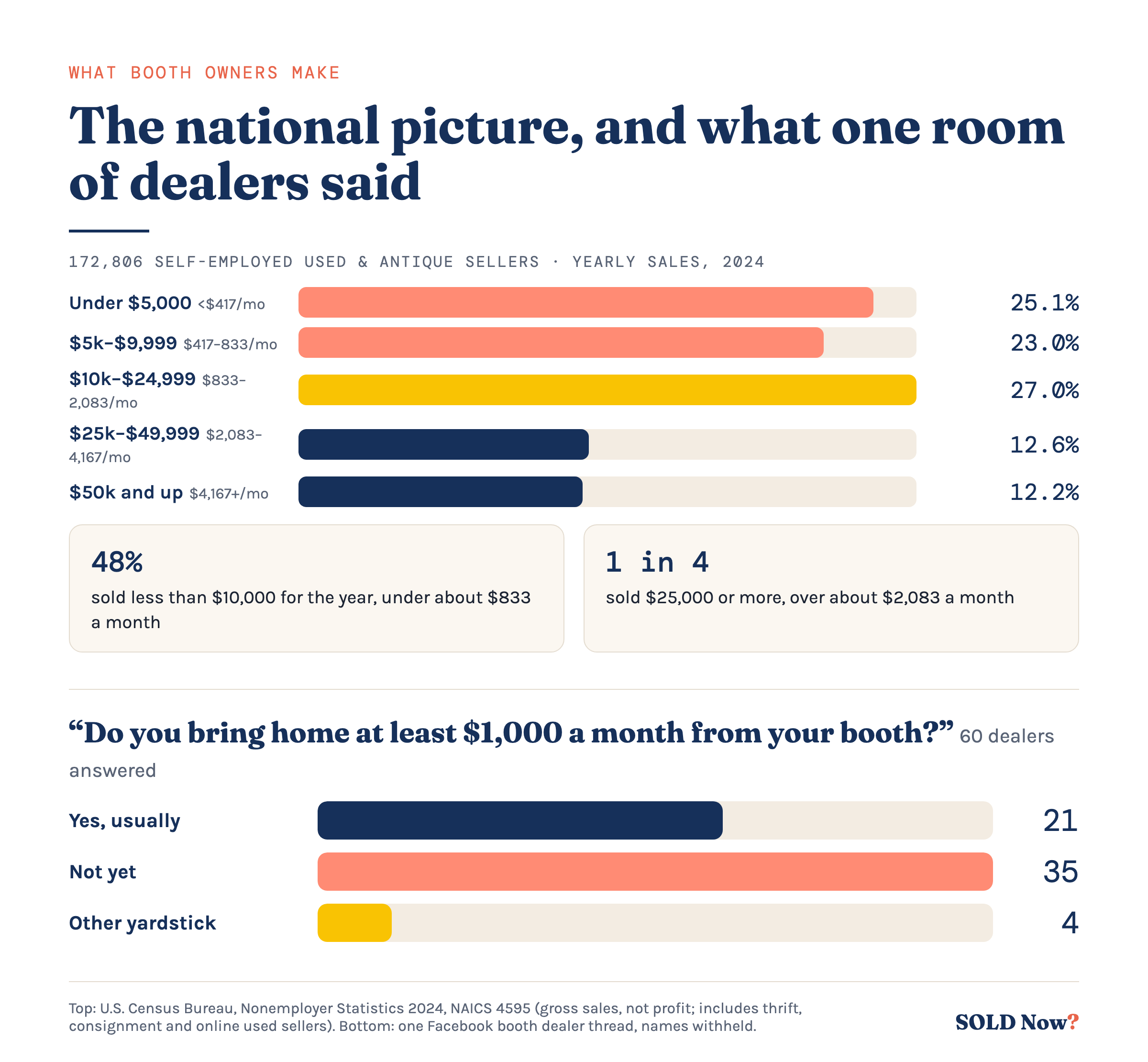
No one tracks antique booths on their own, but the closest national data says most small used and antique sellers do modest numbers. In 2024, U.S. Census figures for 172,806 self-employed used merchandise sellers show just under half sold less than $10,000 for the whole year (under about $833 a month), and one in four sold $25,000 or more. When 60 booth dealers were asked “do you bring home at least $1,000 a month?”, 21 said yes, usually, and 35 said not yet. The dealers clearing $1,000 or more weren't selling pricier things. They kept the booth full, priced from their own margin, showed up often, and knew what sells in their mall.
That's the short answer. The longer one is worth reading, because the gap between a booth that pays rent and a booth that pays you mostly comes down to how it's run, and you can see that in your own numbers.
Is there an official average for booth income?
Not for booths specifically. A 2026 guide from Underpriced that checked booth rent at 35 antique malls says it plainly: “Nobody publishes reliable averages” for what vendors earn (Underpriced (opens in a new tab), updated October 14, 2026). We looked for vendor sales data from the software malls use to run their registers and payouts, and didn't find any published.
What does national data say about used and antique sellers?
The biggest dataset that includes booth dealers comes from the U.S. Census Bureau. Its Nonemployer Statistics count every business with no paid employees that reports at least $1,000 in sales to the IRS, sorted by industry. Booth dealers who file as a business usually land in “used merchandise retailers,” the same category as antique shops, thrift and consignment shops, and online sellers of secondhand goods (U.S. Census Bureau, Nonemployer Statistics (opens in a new tab), 2024 data).
In 2024, that category held 172,806 self-employed sellers. Here's how their yearly sales broke down:
| Yearly sales | About per month | Share of sellers |
|---|---|---|
| Under $5,000 | under $417 | 25.1% |
| $5,000–$9,999 | $417–$833 | 23.0% |
| $10,000–$24,999 | $833–$2,083 | 27.0% |
| $25,000–$49,999 | $2,083–$4,167 | 12.6% |
| $50,000 or more | $4,167 or more | 12.2% |
So just under half (48%) sold less than $10,000 for the year, the middle seller landed between $10,000 and $25,000, and about one in four sold $25,000 or more. The average works out to about $31,000 a year, but a few large sellers pull that up; the typical seller is well below it.
Two things to keep in mind. These are gross sales, before what you paid for your stock, rent and commission. And the category mixes booth dealers with thrift shops, consignment shops and online sellers, so it's the national backdrop, not a booth-only number.
The other honest data point is what dealers say when someone simply asks.
What did 60 booth dealers say?
Someone in a booth dealer group on Facebook asked the room: “For those of you that rent a booth, do you bring home at least $1,000/month minimum?” Partway through, a newer dealer asked everyone making $1,000 or more to share how they do it. This post is our attempt at that answer. We read every reply. Of the 60 people who answered directly:
- 21 said yes, usually.
- 35 said not yet.
- 4 answered with a different yardstick or advice instead of a yes or no.
On the yes side, people described $1,000 a month from each of three booths, $1,400 or more from each of two, “closer to $2,000,” $2,000 to $3,000, $3,000 to $5,000, and $2,000 to $3,000 in the booth plus about the same again on eBay. One dealer treats $1,000 as the monthly floor and has missed it once in two and a half years. Another moved from a shelf to a full booth this summer with a $1,000 goal and has missed it once.
On the not-yet side, people described $400 to $700 in a good month, about $500 from a 10x5 booth, $200 months on $125 rent, $390 one month and a $40 payout the next, a first month that covered the $175 rent and nothing more, and a shelf that sold $70 in its first month. Four of the not-yet answers mentioned a small or rural town.
It's worth noticing that “not yet” doesn't always mean “not working.” One dealer pays $140 in rent and had sales of $850 their first month and $743 so far in the month they posted. That's under $1,000, and it's also more than five times their rent.
This is one thread, not a survey, and “bring home” meant different things to different people. Some were talking about total sales and some about the check after rent and commission; one dealer pointed out that their number doesn't include cost of goods or rent. But the spread is real, and it lines up with the national picture: a big group of sellers doing a few hundred dollars a month, and a smaller group doing well over $1,000.
What does a booth have to sell to break even?
Start with rent. Underpriced found a median of $275 a month for a booth around 10x10, with a range of $100 to $500. Most of the malls they checked (21 of 35) also keep a commission, most often 10%, and 7 add a 3% to 4% card fee (Underpriced (opens in a new tab)).
At that median rent and a 50% margin on what you sell, a booth needs $550 in sales just to cover rent. Add a 10% commission and a 3% card fee, and break-even climbs to $744.
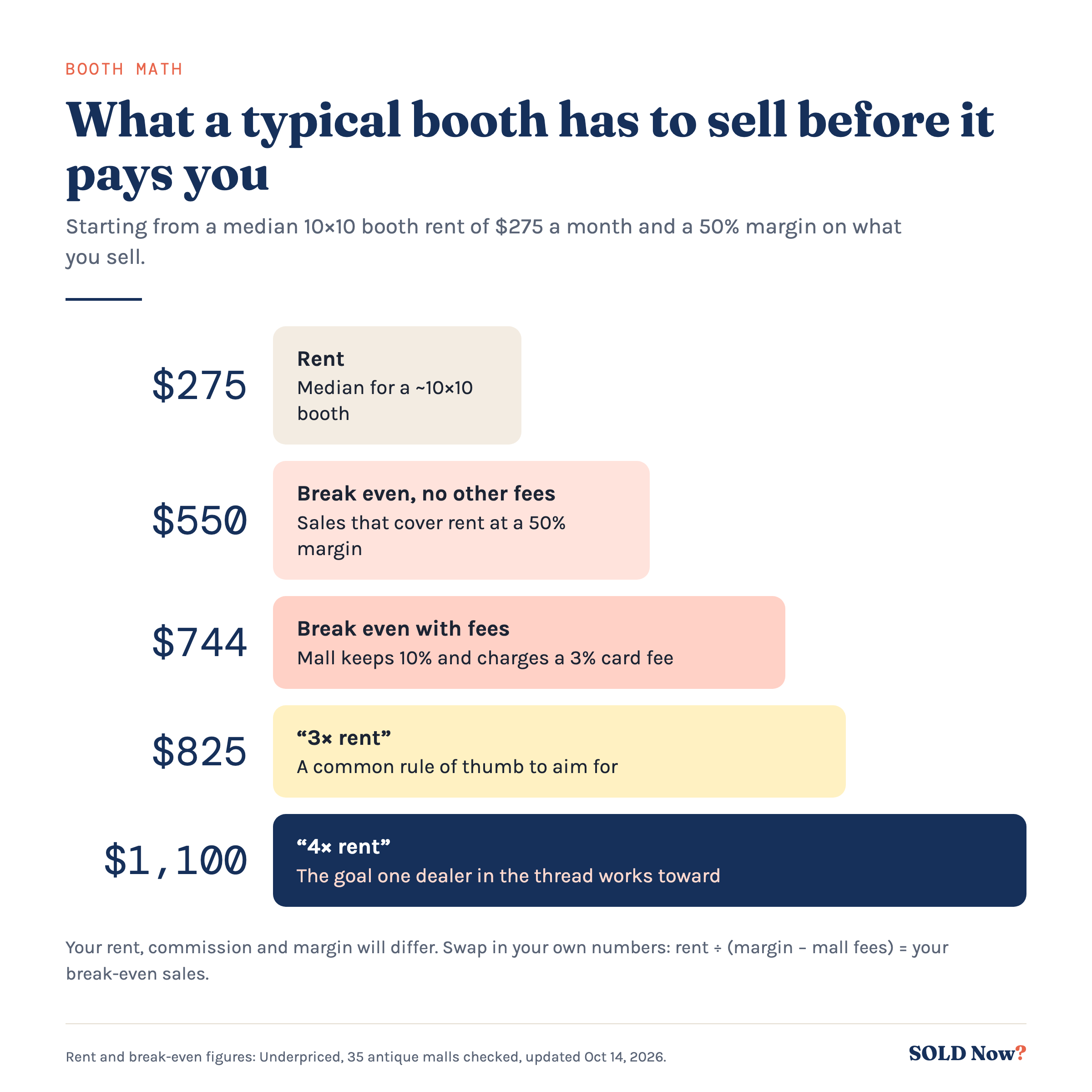
That's why so many dealers measure a booth in multiples of rent instead of dollars. One longtime vendor was told early on to aim for “at a minimum” three times rent (Adirondack Girl at Heart (opens in a new tab)). In the Facebook thread, one dealer said they aim for four times their rent, and another said they triple theirs. On a $275 booth, three times rent is $825 and four times is $1,100, which is right where the “$1,000 a month” question lives.
The quick answer: A typical booth has to sell somewhere around $550 to $750 a month just to break even. The dealers who bring home $1,000 or more usually sell three to four times their rent, by moving a lot of fairly priced pieces from a booth they restock often.
If you want to check your own break-even, divide your rent by your margin after mall fees. At a 50% margin with 13% in fees, that's rent ÷ 0.37.
How do booth owners who hit $1,000 a month work their booth?
Reading the yes answers side by side, the same handful of habits kept showing up.
1. They price from their margin, not the book value
The most detailed answer came from a dealer with two booths, one of them a 12x4, each doing $1,400 or more a month. Their items aren't expensive. They described buying a piece for $5 that might be “worth” $50 and happily tagging it at $20 or $25. They sell 65 or more items a month from each booth, and another member worked out their average sale at about $22.
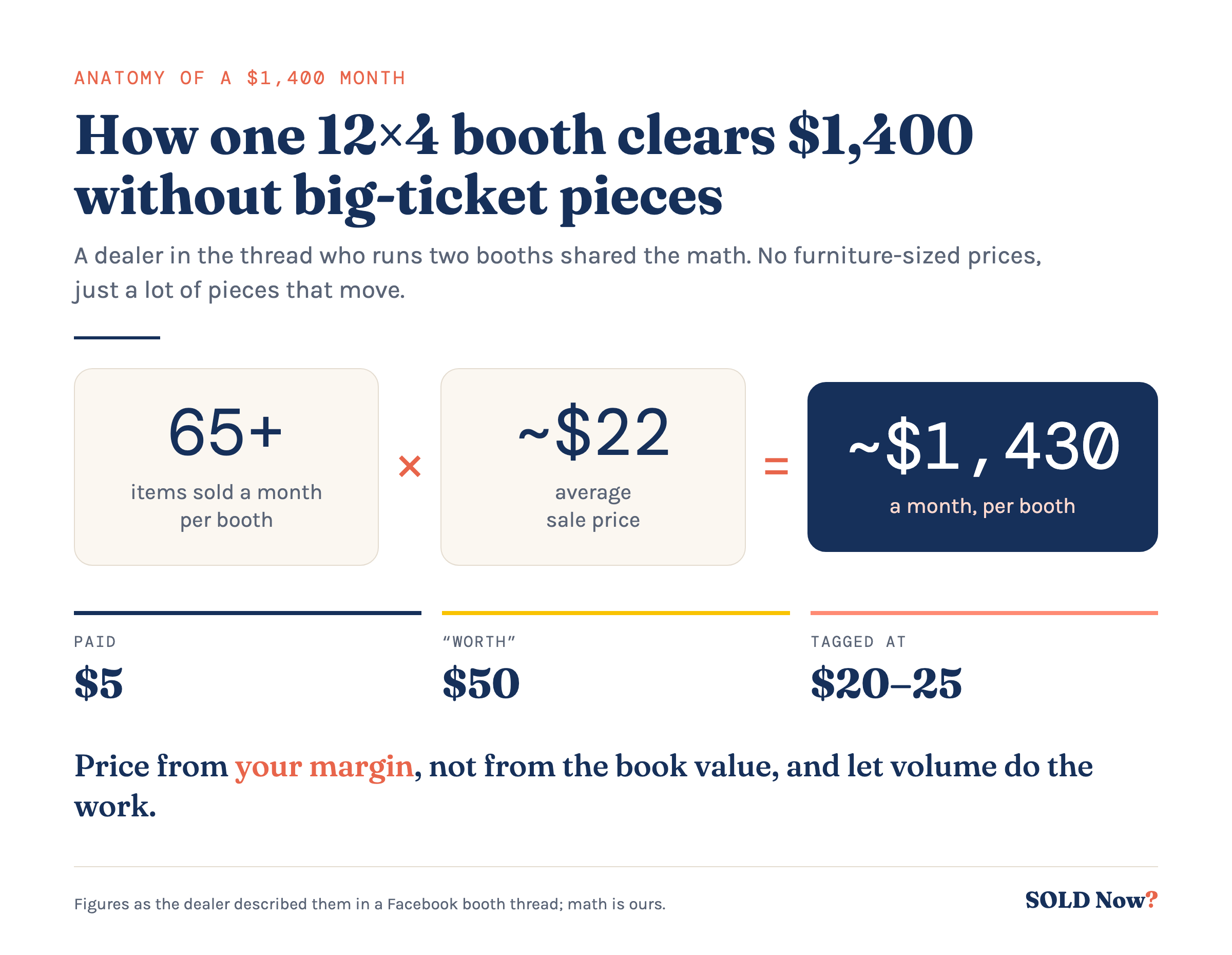
Sixty-five pieces at $22 is about $1,430. Nothing in that math needs a sideboard. It needs a booth that turns over, and prices that let shoppers say yes on the spot. If you want to see what a single piece actually earns you after fees, our free Profit Calculator works it out for you.
2. They buy what moves in their area
One dealer who's been hitting $1,000 lately said they don't source a ton and their booth is on the smaller side; they buy the items they know will move fast and price them right. A dealer with three booths doing $1,000 each said it comes down to decent store traffic and desirable inventory, attractively priced. A newer dealer said they watch eBay and Whatnot to see what's in demand right now. Another put it as knowing what's selling in your area. That's a local answer, not a national one. What flies off the shelf in one mall can sit in the next town over. (If you're curious what younger shoppers are reaching for, we wrote about what younger shoppers are buying in antique malls.)
3. They keep the booth full and fresh, and they show up
One dealer noticed that the vendors who make $1,000 a month in their store come in at least twice a month, and keep the booth neat and refreshed. Another, who's hit $1,000 every month but one since moving into a full booth, said being at the booth, bringing in new things and moving things around makes a big difference. A dealer with a 10x5 booth said they can average about $500, but only if they actually work the booth. Underpriced's guide says a booth “needs fresh inventory at least every week or two,” and suggests visiting weekly when you can. A full, tidy booth reads as new to a shopper who walked past it last week.
4. Space and spot matter
Several answers came back to the room itself: how big the space is, where it sits in the store, and how many shoppers walk past it. One dealer who said no has a small booth and a two-year waiting list for a bigger one. Another is upstairs in a building without an elevator. Another is in a small town with no evening hours, and three more mentioned small, rural or tourist towns. One dealer who said yes shares two adjacent booths with two friends, keeps them heavily stocked, and says they all do well. Underpriced's guide ranks foot traffic above everything else when you choose a mall.
5. They count profit, not just sales
One reply was short and right: remember to subtract the cost of your items. A $1,000 month at a 20% margin and a $1,000 month at a 60% margin are very different months. The dealers with the clearest answers knew their numbers, down to how many items they sold and what the average ticket was. One newer dealer said they're keeping notes each month on how the booth was set up, their best sellers and their pricing. That's exactly the right instinct.
6. They give a booth time
Several of the not-yet answers came from people one to eight months in, and some were thinking about pulling the plug. That's a fair call to make, but make it with a few months of numbers in hand. Underpriced suggests giving a new booth at least three months before you judge it.
How do you know which items and which booths are working?

Every habit above depends on knowing your own numbers, the same notes that newer dealer is keeping by hand: which pieces sell, which booth earns its rent, and what's been sitting. A mall statement tells you what sold. It doesn't tell you what you paid for it, what you cleared after rent, or how this booth compares with your other one.
That's the question we built SOLD Now to answer, because we needed it for our own booths. Marissa's Home sells vintage kitchenware and décor from two booths, at Lone Star Mercantile in Allen and The Crush Warehouse in Plano, and SOLD Now price tags ring up at the registers in both.
In SOLD Now, each booth is its own location. Every sale already carries what you paid for the piece, and when you log booth rent as a business expense, your reports show real profit by item, by month and by location. That's the view that tells you which booth is working, which one needs a refresh, and which category is carrying the month. These reports, locations and expenses are on the Gold plan.
The Location Audit report helps with the other half: it lists everything that should be in a booth right now, with each piece's price and the date it was listed, so you can walk the shelves with a checklist and spot what's been sitting.
What should you do when the report shows a winner?
Lean into it. Here's how that looks in practice.
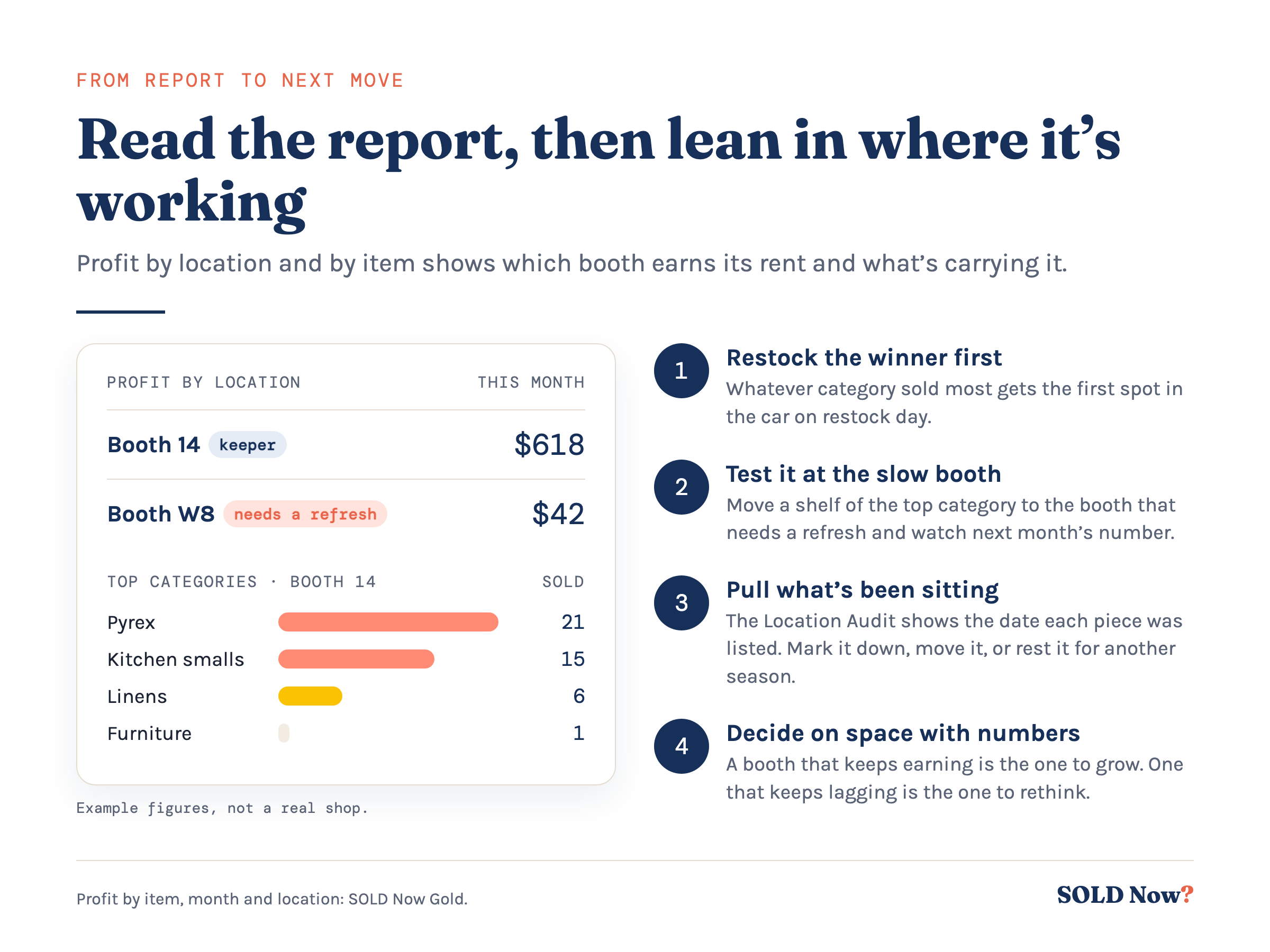
- Restock the winner first. If Pyrex or kitchen smalls carried the month, that category gets the first spot in the car on restock day.
- Test it at the slower booth. Move a shelf of your best category into the booth that's lagging and see what next month's number does. Same pieces, different room, real answer.
- Pull what's been sitting. Use the listed dates to find pieces that have been in the booth for months. Mark them down, move them to the other booth, or rest them until a better season. Our post on what to do when booth sales are slow has more on reading slow months.
- Make space decisions with numbers. A booth that keeps earning is the one worth more square footage when a bigger spot opens up. One that keeps lagging after a real refresh is the one to rethink.
None of this needs a big Saturday with a highlighter. Once your pieces live in one place, the report is just there when you want it.
Frequently Asked Questions
How much does the average antique booth make a month?
No one publishes a booth-only average. U.S. Census data for 172,806 self-employed used and antique sellers shows that in 2024 just under half sold less than $10,000 for the year (under about $833 a month), and about one in four sold $25,000 or more. In one Facebook thread, 21 of 60 booth dealers said they usually bring home $1,000 or more a month.
How much does an antique booth cost to rent?
A 2026 check of 35 antique malls found a median of $275 a month for a booth around 10x10, with a range of $100 to $500. Many malls also keep a commission, most often 10%, and some add a card fee.
How much does a booth need to sell to break even?
At $275 rent and a 50% margin, about $550 a month. With a 10% commission and a 3% card fee, about $744. Many dealers aim for three to four times their rent in sales.
How do I know if my antique booth is profitable?
Subtract what you paid for the pieces that sold, the mall's commission and fees, and your rent from your booth's sales. If you track each booth as its own location, you can compare profit booth by booth, month by month.
Built for resellers, by resellers.
Sources
- Underpriced, “How Much Does an Antique Mall Booth Cost? Rates From 35 Malls,” updated October 14, 2026 (opens in a new tab)
- Adirondack Girl at Heart, on making money with an antique booth, published June 9, 2020, updated July 7, 2026 (opens in a new tab)
- U.S. Census Bureau, Nonemployer Statistics 2024, United States file, NAICS 4595 (used merchandise retailers), establishments by receipts size class (opens in a new tab) (data file)
- A Facebook booth dealer group thread, names withheld