Blog Pricing & offers
Holiday Pricing for Vintage: Don’t Leave Money on the Table
Set your floor, price from sold comps, save your sales for Thanksgiving weekend, and price gifts so they sell and still pay you.

Part 2 of our Thriftmas 2026 series. Built for resellers, by resellers.
Holiday pricing for vintage starts before the holidays. Know the lowest price each piece can sell for and still pay you, check what the same thing actually sold for recently, and price from that. Then hold full price on your most giftable pieces, save your sales for Thanksgiving weekend, and decide ahead of time what gets marked down and when.
This year's shoppers say they're comparing prices and waiting for deals, so a price you can back up with sold comps does more work than a lower one. In Part 1 of the series we covered what Thriftmas is and what sells. This part is about the number on the tag.
What do holiday shoppers say about prices this year?
The National Retail Federation's 2026 holiday survey (opens in a new tab), published October 20, asked 8,094 adults about their plans. A few findings matter for anyone pricing vintage:
- More than half (56%) say the economy will affect their holiday spending. Of those, 43% plan to shop sales more often, 31% will compare prices online more often and 29% will use coupons more often.
- 64% say they're likely to wait until Thanksgiving weekend to do most of their shopping.
- 43% plan to start browsing and buying before November, and half of those early shoppers say they start early to spread out their budget.
Put together: some gift buyers are already looking, most say they'll do the bulk of their shopping over Thanksgiving weekend, and many will check your price against someone else's before they buy. That doesn't mean slash everything. It means know your numbers well enough that you can hold a fair price, and run your sales when people are actually shopping for them.
What should you know before you set a holiday price?
Two numbers: your floor and your comps.
Your floor is the least a piece can sell for and still pay you. Add what you paid, the platform fees, shipping and packing if it's going online, and a share of booth rent if it's sitting in a booth. If your time matters to you (it should), count that too. The free Profit Calculator does the math for one piece: enter the sale price, what you paid, fees, shipping and packaging, and the minutes you spent, and it shows your profit, your margin and what you earned per hour.
Your comps are what the same item, in the same condition, actually sold for, not what people are asking. On eBay, the free Product Research tool (opens in a new tab) under the Research tab in Seller Hub shows real sales data and recent price trends. Look at the whole range of sold prices, and match condition before you compare.
Write both numbers down before the rush starts. In December you won't have time to look them up for every phone call from the mall or every offer that pings your phone.
Should you raise prices for the holidays or lower them?
Usually neither. Price where your comps say the piece sells, and let the season do the work.
A one-of-a-kind gift piece, the Fire-King mug that matches the one Mom drank from, is not something a shopper can find in ten other places. Holding a fair, comp-backed price on it through early December is reasonable. A common piece with dozens of matching listings is different: shoppers comparing prices online will find the cheaper one, so price it to sell or bundle it into something nobody else has.
The pieces that need a nudge are the ones that have already sat. Those are what your holiday sale is for.
How does Marissa's Home price for the holidays?
Before I wrote this, I pulled last November and December out of SOLD Now to see what I actually did, not what I remember doing. Three things stood out.
I didn't mark anything down for the holidays. My November and December prices followed the same pattern as September and October, and holiday shoppers still bought.
Almost every holiday price ended in .49. That's $9.49, $28.49, $149.49. Earlier in the year I priced in whole dollars. It's a small change, and it lines up with the research on precise prices further down this post.
The little gift pieces kept moving right up to the end. Christmas mugs, tea towels, a Santa cookie jar, a snowman candle holder and a cardinal wine glass sold all through December, the last ones on December 27. Most were priced between about $5 and $25. My Blind Dates sold alongside them. They work like a “blind date with a book,” only with a vintage piece and a whole experience around it. A Blind Date with a vintage teacup might come with tea, a spoon, an infuser, a honey stick, a little candy, a coaster or doily, cozy socks and a card about the teacup and its history. Each one is a little different, so no two are the same.
None of it took a holiday pricing scramble. I priced each piece fairly once, kept the small gift pieces stocked, and let the season do the rest.
When should you run holiday sales?
Thanksgiving weekend, when 64% of shoppers say they'll do most of their buying. In 2026 that's:
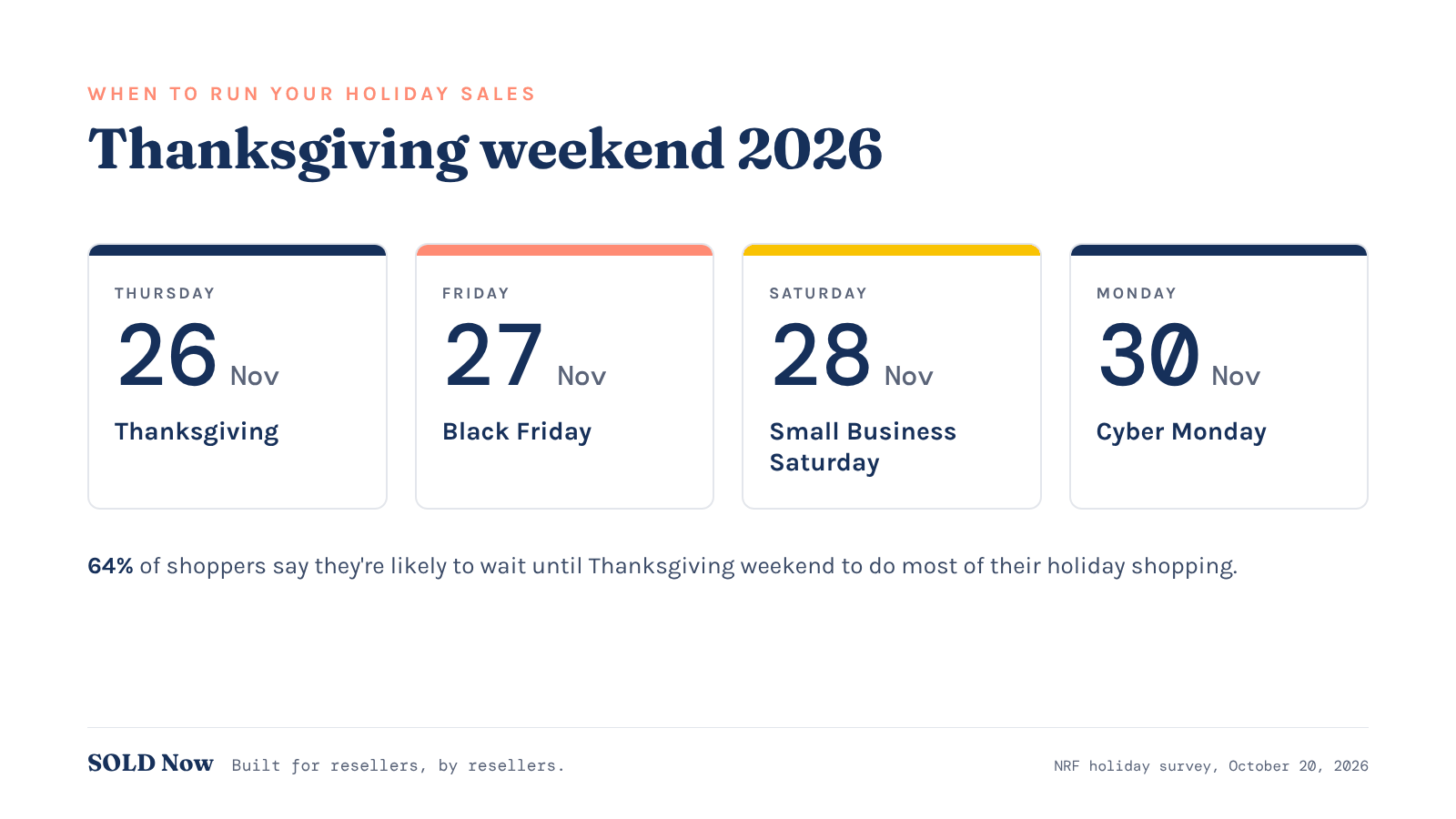
| Day | Date |
|---|---|
| Thanksgiving | Thursday, November 26 |
| Black Friday | Friday, November 27 |
| Small Business Saturday | Saturday, November 28 |
| Cyber Monday | Monday, November 30 |
Set up your sales a few days before, so you're not doing it at midnight on Thanksgiving. The tools depend on where you sell:
- Etsy: in Shop Manager, go to Marketing, then Sales and Discounts. You can run a sale (a percentage off or free standard shipping), create a promo code (from 5% to 75% off, in whole numbers), or set up a discounted bundle of up to three listings. If you set a minimum order to qualify, the sale covers your whole shop. Etsy can also email offers to shoppers who left your item in their cart or favorited it, if they've opted in to marketing emails. (Etsy Help (opens in a new tab))
- eBay: if you have an eBay Store, go to Marketing in Seller Hub, then Discounts. Select Create discount, choose Sale event, and set a percentage or dollar amount off. Sale prices show in eBay search results and on the listing. (eBay Help (opens in a new tab))
- Your booth: check your mall's rules on sale tags and dealer discounts before you plan anything. Every mall handles this differently.
A sale is a tool for the pieces that need to move. You don't have to put everything on it.
Should you price at round numbers?
It depends on whether you'd rather hold the price or sell faster.
Economists from eBay Research, Cornell and UC Berkeley studied 10.5 million listings (opens in a new tab) in eBay's collectibles category (coins, antiques, toys, memorabilia). Items listed at multiples of $100 sold for 5 to 8% less than items at nearby precise prices. They also got offers 6 to 11 days sooner and were 3 to 5% more likely to sell. The researchers read a round number as a signal that the seller is ready to come down. Our post on how to handle offers on antiques and vintage covers what this means for counteroffers.
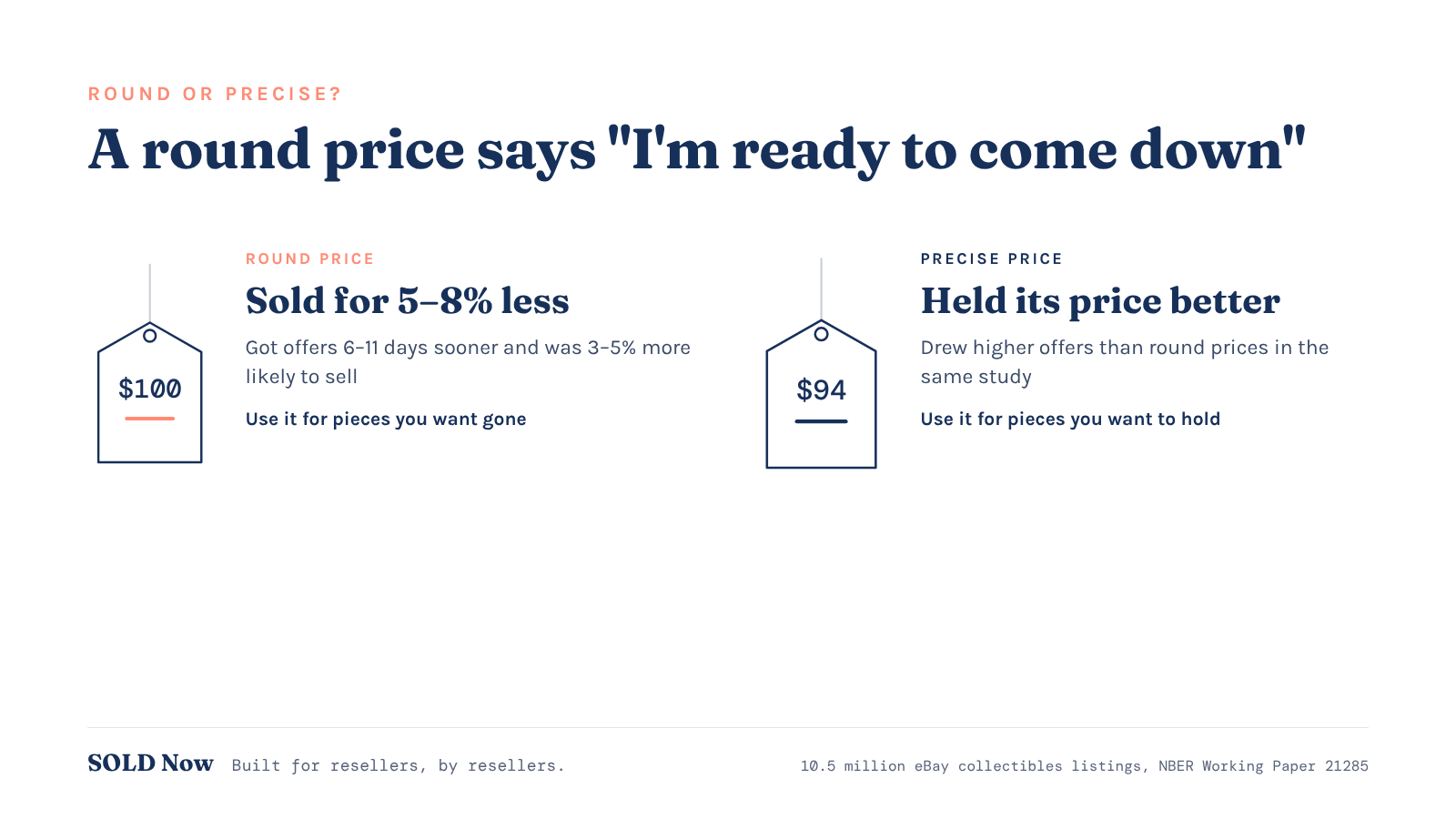
So for holiday pricing: a precise price, like $94 or $108 instead of $100, suits the pieces you want to hold. A round price suits the pieces you'd like gone before Christmas. The study was about prices at multiples of $100, so treat it as a nudge for your bigger pieces, not a rule for every tag.
How do you price a vintage gift bundle?
In Part 1 we suggested bundling: a vintage mug, a cookbook and a tea towel make a ready-to-wrap gift. Pricing one is simple.
- Look up the comp for each piece on its own.
- Add them up. That's what the buyer would pay piece by piece.
- Take a little off, enough that the bundle reads as a deal.
- Check the bundle price against the floors of all three pieces added together. It never goes below that.
On Etsy, the discounted bundle tool handles step 3 for you; step 4 is still yours to check. In a booth, a bundle in a basket with one tag is easier on the shopper than three loose tags.
How should you price gifts in a booth?
Make it easy for a gift shopper to find something in their budget. A gift table with small signs, “Under $25,” “Under $50,” “Under $100,” turns your booth into a gift shop for someone holding a list. Part 1 suggested a Thriftmas gift table; price points are what make it work.
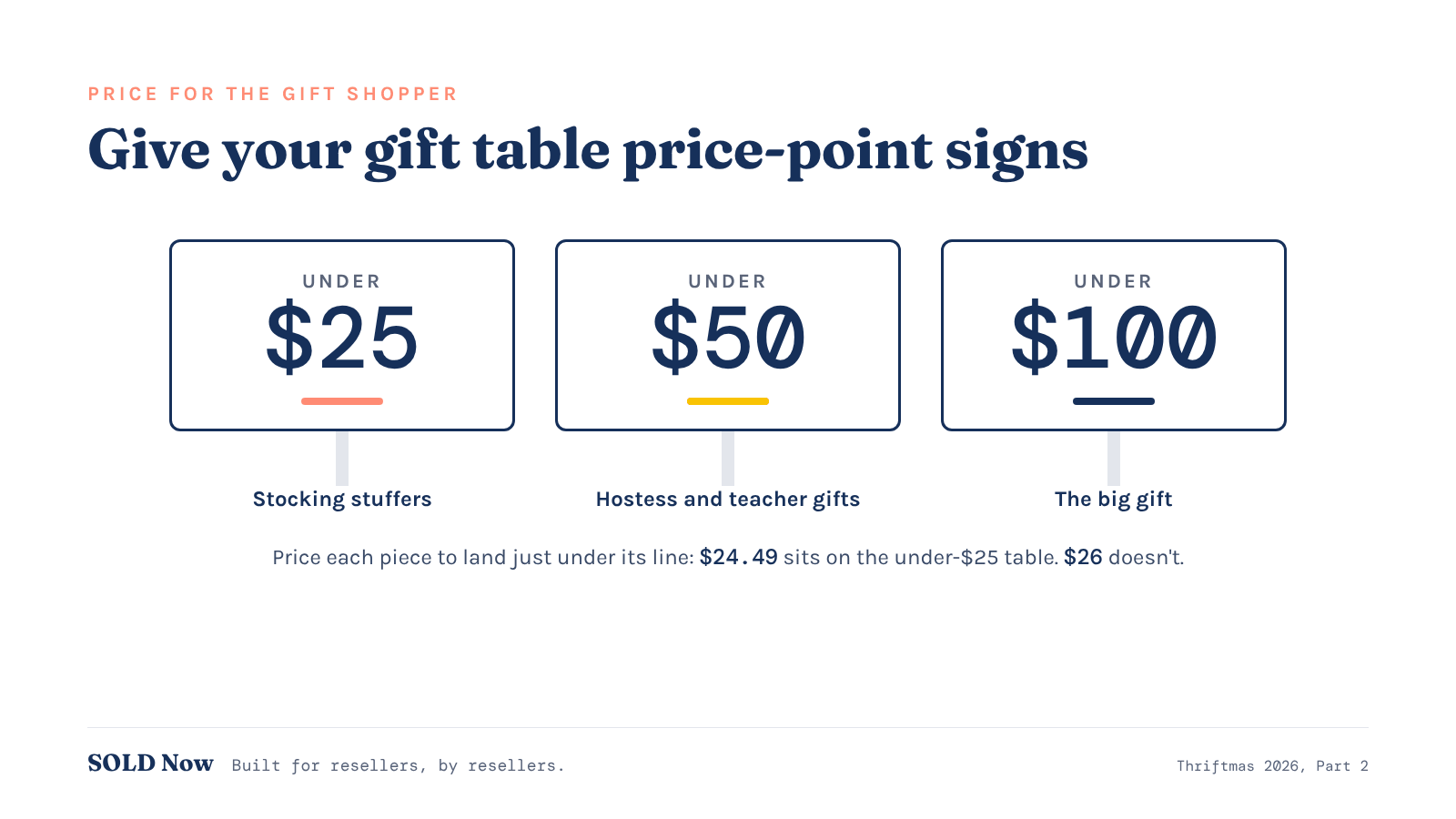
Price the pieces on that table to land just under each line. A $24.49 piece on the under-$25 table sells as a stocking stuffer. The same piece at $26 is on the wrong table.
What happens after your last ship-by date?
Once the carriers' last ship-by dates pass, a piece bought online won't arrive in time for Christmas. Our post on hidden fees for resellers lists the 2026 ship-by dates. After that, your booth and local pickup carry the gift sales, so keep your gift pieces priced and stocked there.
Christmas décor is the one category with a hard stop. Decide now what you'll do with what's left on December 26: box it for next year or mark it down to clear. Either is fine. Storing it costs you space for eleven months, and that's worth counting before you decide.
A simple holiday pricing routine
- Before November: write down the floor and the comps for every gift-worthy piece.
- Price to comps, not to the calendar. Hold fair prices on one-of-a-kind pieces; price common pieces to sell.
- Set up your Thanksgiving weekend sales a few days early, on the pieces that have sat, not on everything.
- Use precise prices on what you want to hold, round prices on what you want gone.
- Bundle, and never let a bundle drop below the floors added together.
- After your last ship-by date, move gift pieces to the booth and local pickup, and decide what happens to the Christmas décor.
| The piece | The usual move |
|---|---|
| One-of-a-kind, strong comps, new to the floor or just listed | Hold a fair, precise price through early December |
| Common piece with lots of matching listings | Price it to sell, or bundle it |
| Has sat for months | Put it in your Thanksgiving weekend sale |
| Small and under $25 | Gift table or stocking stuffer pile, priced just under the line |
| Christmas décor still there December 26 | Box it for next year or mark it down; decide before the holidays |
The quotable answer: Price holiday vintage from your floor (cost, fees, shipping and rent) and your sold comps, not from the calendar. Hold fair prices on one-of-a-kind gift pieces, save sales for Thanksgiving weekend, when 64% of shoppers in NRF's 2026 survey said they're likely to do most of their shopping, and use them on the pieces that have already sat.
Where SOLD Now fits
All of this is easier when you can look up what a piece cost and how long it's been sitting instead of digging for a receipt. On SOLD Now Gold ($39.99 a month), every piece keeps what you paid and where it is, and reports and profit dashboards show what you actually kept after fees. If you'd rather not research comps one by one, Platinum ($59.99 a month) adds AI pricing researched from sold listings. Every paid plan starts with a 30-day free trial, and Bronze is free forever. See plans and pricing.
Frequently Asked Questions
Should I raise my prices for the holidays?
Usually not. Price where your sold comps say the piece sells. Holiday shoppers are comparing prices this year: 31% of those worried about the economy say they'll comparison shop online more often, per NRF's 2026 survey. A fair, comp-backed price holds up to that.
When should resellers run holiday sales?
Thanksgiving weekend: Black Friday, November 27, through Cyber Monday, November 30, in 2026. In NRF's 2026 survey, 64% of shoppers said they're likely to wait until Thanksgiving weekend to do most of their holiday shopping.
Should I price vintage at round numbers?
Precise prices tend to hold better. In a study of 10.5 million eBay collectibles listings, items at multiples of $100 sold for 5 to 8% less than items at nearby precise prices, but sold sooner and were more likely to sell.
How do I price a vintage gift bundle?
Add up the sold comps for each piece, take a little off so the bundle reads as a deal, and make sure the total never drops below the floors of all the pieces added together.
How do I know the lowest price I can take?
Add what you paid, platform fees, shipping and packing for online sales, a share of booth rent for booth sales, and the value of your time. The free SOLD Now Profit Calculator does the math for one piece.
This is Part 2 of our Thriftmas 2026 series. Missed Part 1? Thriftmas Is Here: Your Reseller's Guide to the Secondhand Holiday. Next up, Part 3: the Thriftmas Gift Guide.
Built for resellers, by resellers.
Sources
Platform help pages checked October 27, 2026. Rules change, so check the link before you lean on it.
- National Retail Federation, “Affordability Shapes Winter Holiday Shopping, According to NRF Holiday Survey,” October 20, 2026 (8,094 adults, surveyed October 1–7) (opens in a new tab)
- NBER Digest, “Cheap Talk, Round Numbers, and Signaling Behavior,” September 2015, summarizing Backus, Blake and Tadelis, NBER Working Paper 21285 (opens in a new tab)
- Etsy Help, “How to Set Up Sales and Discounts for Your Shop” (opens in a new tab)
- eBay Seller Center, “eBay research tools” (opens in a new tab)
- eBay Help, “Discounts Manager” (opens in a new tab)