Blog Live selling
Whatnot Raid Trains: How to Join One, Run One, and Keep Buyers Riding
How raid trains really work — finding one, riding one, and running one — plus two free printable workbooks for sellers and conductors.
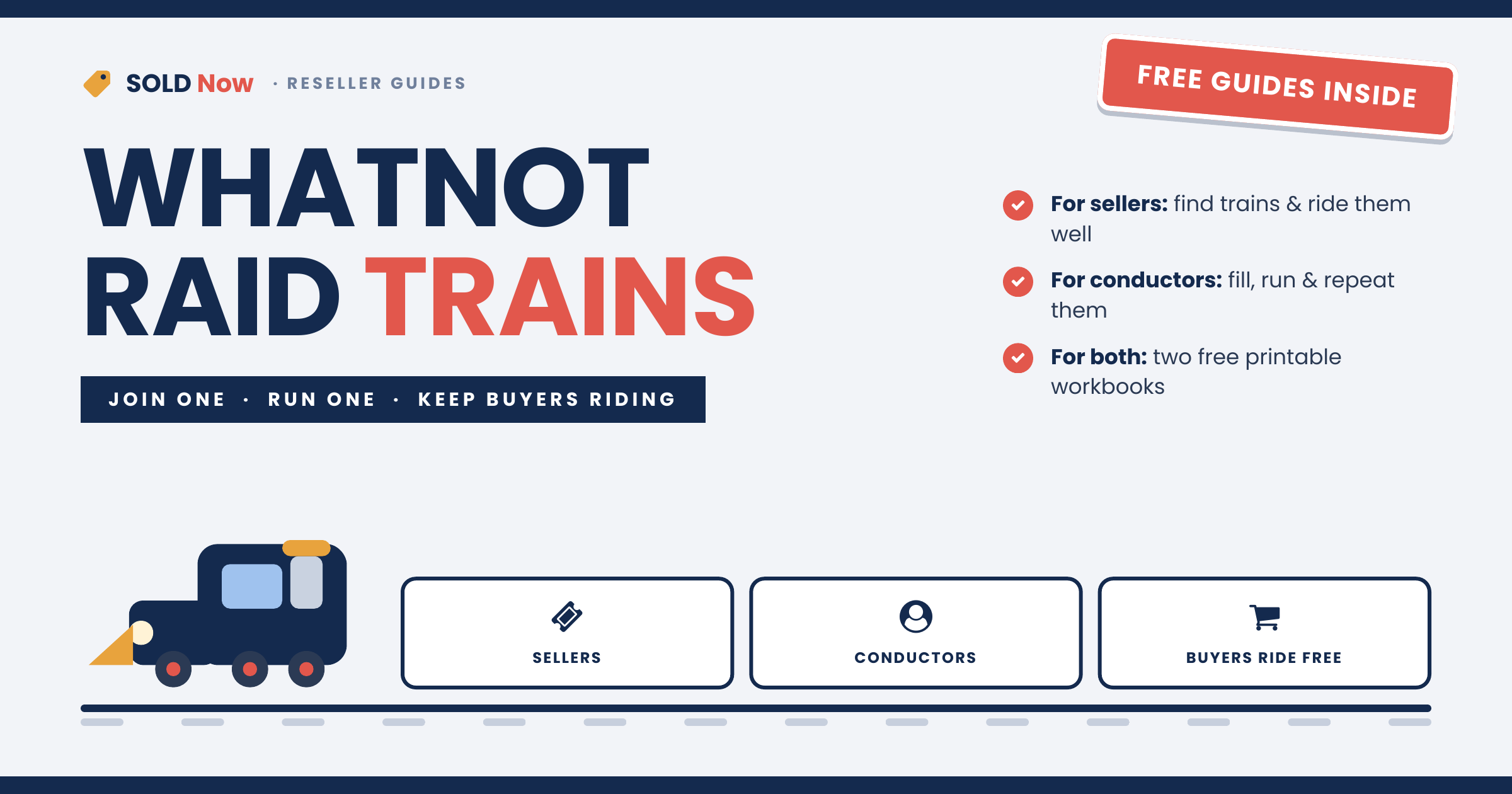
A raid train is the best day on Whatnot that nobody fully explains to you.
Here's the short version: a group of sellers runs live shows back to back, each one claiming a car — a time slot named for when it goes live, like “Car 1:00pm.” When a seller's time is up, they raid their whole audience over to the next seller in line. Buyers ride from car to car, arriving at each show already warm, already shopping.
And here's the part the short version leaves out: real raid trains are big. Lineups start around eighteen sellers and often run to double or triple that, in fifteen- and thirty-minute cars, across an entire day. Somewhere behind all of it is one person — the conductor — holding the whole schedule together, usually in a spreadsheet, usually while also running their own shows.
We've watched both sides of that day up close. This guide is for both of them. (And if you'd rather have it on paper next to your setup, we made two free printable workbooks — one for sellers, one for conductors. The signup is at the bottom.)
Part 1 · For sellersHow to Ride a Raid Train
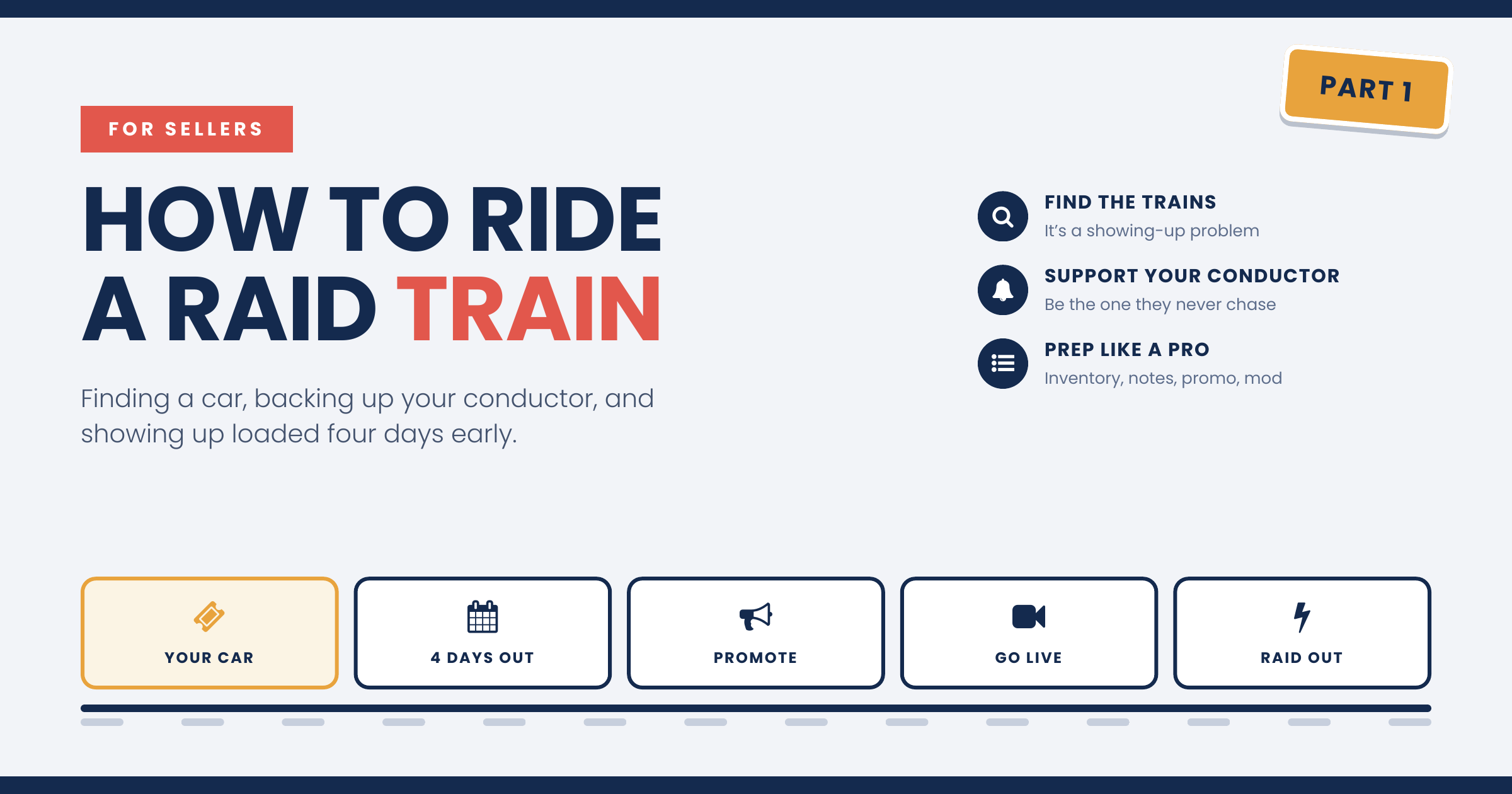
Finding a train is the hard part nobody warns you about
There's no master schedule of raid trains on Whatnot. Trains fill in Facebook groups, Discord servers, and DMs — and most cars go to sellers the conductor has already seen somewhere, being decent in somebody's chat.
Which means finding trains isn't really a search problem. It's a showing-up problem.
- Be present in shows in your niche. Watch, chat, buy a little, follow. Conductors build lineups out of the people they already recognize.
- Say you're interested, specifically. “I'd love a car on your next train — I sell vintage linens and I'm usually free weekday mornings” gets a very different answer than “lmk if you ever need sellers.”
- Read show notes on trains you watch. The lineup is usually right there, and so is the conductor's handle.
- Check the Billboard. Conductors who build their trains with SOLD Now's free Raid Train Manager can list them on a public Billboard — a page of trains from conductors who are actively looking for sellers. It exists because “how do I find a train?” deserved a better answer than “know somebody.”
And once you've ridden one train well — on time, prepared, kind in chat — the finding problem mostly solves itself. Reliability is the résumé here.
The setup: how to be the seller conductors fight over
A conductor coordinating thirty sellers is chasing thirty confirmations. You can be the one they never have to chase.
- Claim your car promptly and confirm it. Then check your time against the train's official time zone, not your assumption of it.
- Answer the reminders. Conductors repeat the same asks before every train — be ready, update your notes, prep your giveaway. That's the job, not nagging. Answer anyway.
- Use the thumbnail the conductor provides. Every time. The matching thumbnail is how the train reads as one event — and if the train derails and a buyer gets dropped mid-ride, that shared image is how they spot the train in the feed and climb back aboard. Your custom graphic might be prettier. Use theirs.
- Put the train's name in your show title, exactly as the conductor wrote it.
- If you're running late or your stream drops, message the conductor immediately. A delay gives them options. Silence gives them nothing, and the whole train depends on the next handoff.
Prepping your show: the work that happens before the raid lands
The sellers who have great trains aren't luckier. They're loaded four days earlier.
Inventory. Pre-load 25–60 auction items about four days out. Pre-loaded listings collect pre-bids — buyers already waiting for you — and they stay live and sellable after the show ends. Save random pulls for your bulk stock; your best pieces deserve a real listing.
Show notes. Paste the full lineup into your show notes and mark your own slot, so a buyer landing anywhere knows exactly where they are:
11:00 @yourhandle ⬅️ YOU ARE HERE
11:30 @coastalfinds · 12:00 @denimanddust
That little arrow does more work than it looks like. Show notes are search, and on a train they're also the rescue map.
Your giveaway. Prepped, photographed, and meeting the train's minimum before show day — not assembled in a panic at 10:40.
Your moderator. Bring your own. A mod who already knows your show style can greet the raid wave, pin the rules, and keep your rhythm going while you stay heads-down selling — exactly when a flood of brand-new buyers lands in your chat.
Promotion. One reel a day the week before, cross-posted where your people are. On show day, DM past buyers: “Bookmark my show — pre-bids welcome!”
And the one that pays for years: follow and bookmark every seller on the lineup, and ride their cars when you can. The biggest prizes on a raid train aren't that day's sales — they're followers, community, and bookmarks. Model the behavior you want and the other lineups' audiences will meet you halfway.
Riding a standing train? That's a different ride.
Some trains run once. The best ones run every week or every month — same name, same day, same time — and holding a car on one changes the math. On a one-time train, the audience meets you once. On a standing train, buyers learn that Saturday 11am is you, and your bookmarks and follows compound every run instead of starting over.
Three things matter more on a standing train:
- Keep the same car every run. On series trains built with the Raid Train Manager, claiming a car offers you that same car across every future show at once — take it; your slot is your address.
- Bring fresh inventory. Returning riders are the same buyers, and last week's thirty items can't run twice.
- Treat your car as a commitment, because that's what it is: when you claimed it, you made a promise to every other seller on the lineup — their handoffs, their buyers, and their whole day run through your car. The train only works if every car shows up. Life happens, and conductors understand that; when it does, release your car or arrange a swap early so they can refill it.
The sellers who hold prime slots for years are simply the ones who never left the group holding their gap.
The full version — checklists, a Plan Your Car worksheet, a promo-week planner, and the chat command cheat sheet — is in the free Seller's Guide below.
Part 2 · For conductorsHow to Run a Train Worth Riding
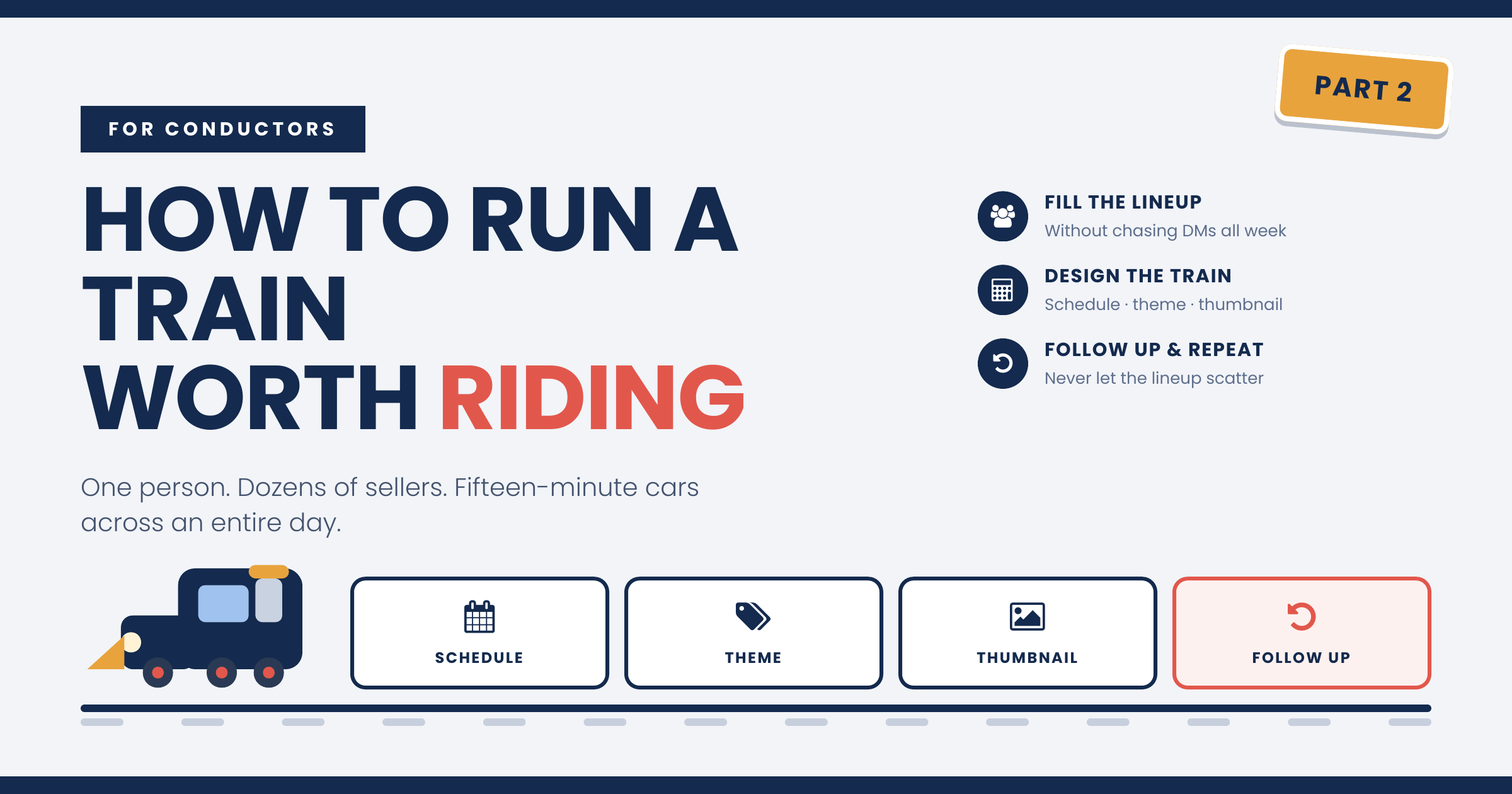
Filling a train is harder than running one
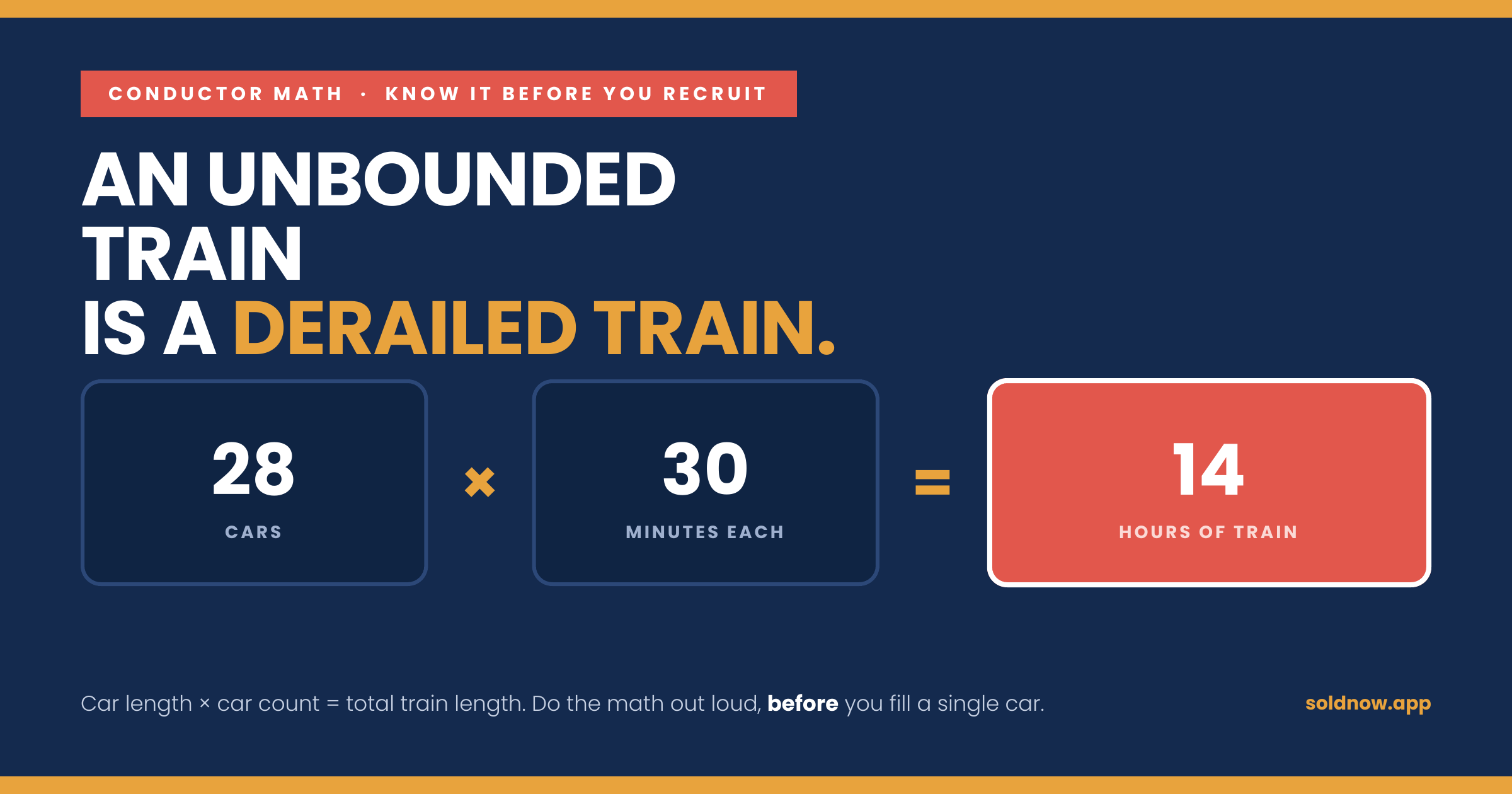
Nobody tells you the math up front, so here it is: car length × car count = total train length. A 28-car train at 30 minutes per car is fourteen hours. And since lineups start around eighteen sellers and don't always stop there, you're not scheduling a show — you're coordinating a day.
You're also not assigning times, because you can't. Your sellers are spread across the country, and a 9pm car is 6pm for someone else. You have no idea which of those is dinner. The only thing that scales is letting sellers claim the times that work for them — which turns your job into the genuinely exhausting part: chasing dozens of confirmations out of group chats and DMs.
One more wall: Whatnot doesn't let you share links. So even when you have a beautiful signup sheet, getting sellers to it is its own puzzle.
Designing the train: schedule, theme, thumbnail
Schedule first. Lock the math before you recruit a single seller. Take the first and last cars yourself — bookend your train. Name a backup seller before the train starts, not after the first no-show.
Then theme. A theme isn't decoration; it's targeting. Look at the trains actually running — vintage variety trains, Disney and Loungefly lineups, spooky Halloween trains, Texas sellers trains, “everything starts at $5” formats — and the same four tracks appear: category, season, community, format. Pick one, collide it with a second for a signature (category × season is how you get a Very Vintage Christmas), name it in five words a buyer can repeat, and set a precise item minimum. “30–50 pieces of vintage nautical” fills cars. “Bring some vintage stuff” fills complaint threads.
Then thumbnail. One matching image on every car, so the whole train reads as one event in the feed — and so a dropped buyer can find their way back. Make it easy for your sellers to use yours: hand it to them with their confirmation.
The Raid Train Manager — and why the right one matters
Your lineup tool isn't admin. It's buyer retention. A public, always-current lineup page — who's live now, who's next, and when — is the single biggest difference between a train buyers ride and one they wander out of after a single car. If the schedule lives in a group chat, every swap and no-show scatters your riders.
So whatever tool you choose, hold it to this list:
- Sellers claim their own cars from one shared link — no login, no back-and-forth.
- It shows two time zones side by side — the show's and the seller's — so nobody miscalculates.
- It captures each seller's Whatnot handle and contact info on the claim, automatically.
- It sends the reminders so you don't spend Thursday chasing.
- It has a QR code, because Whatnot doesn't allow links — the QR is how you reach sellers where they actually are.
- It survives real life: releases, swaps, a live board on show day.
We built the Raid Train Manager to be exactly that list, and it's free on every SOLD Now plan — including Bronze, which is free forever. And if your train works, don't rebuild it: clone it onto a new date in one click, lineup and all, or turn it into a recurring series where your regulars keep the same car all season.
One-time trains are events. Standing trains are institutions.
A one-time train starts the next one from zero. A standing train — same name, same cadence, every week or every month — compounds. Buyers build the habit of coming back on schedule, which means your marketing stops restarting and starts stacking. Your regulars hold their cars across the whole series, so every new date begins half-full and you only recruit for the open cars. Run it long enough and the train's name becomes a brand: sellers start asking you, and you choose lineups instead of chasing them.
But know what you're signing up for, because a standing train is a completely different animal to manage. The moving pieces never stop moving: even with solid regulars, somebody leaves the train almost every week — scheduling, family, life — and on a weekly train that's not an exception, it's the weather. The conductors who last don't fight the churn; they build for it. A live waitlist, a named backup, a tool where a dropping seller can release their car themselves (with a reason that lands in your inbox instead of a silent gap) and two sellers can swap cars without routing through your DMs. Treat every opened car as a guest car — new sellers bring new audiences — and the churn becomes the thing that keeps your lineup fresh.
The other price is consistency. The habit is built by the slow runs nobody remembers, and a train that skips a slow week teaches buyers to skip it back. Pick a cadence you can actually sustain — weekly is powerful and relentless; “first Saturday of the month” is a rhythm most conductors can keep for years.
The follow-up: where almost every train falls apart
Here's how most trains end: the last raid fires, everyone posts a heart in the group chat, and by Tuesday the whole lineup has scattered. Nothing written down, nothing scheduled, and next month's train starts from zero.
You're holding something better than memories. If your signup ran through a real tool, every seller who claimed a car is in your customer list — name, email or phone, Whatnot handle, captured automatically.
- Within 24 hours: thank the whole lineup while it's warm. Name the wins. Shout out the sellers who hyped each other.
- Ask one question: “What's one thing I should change about the next train?” One question gets answers; a survey gets silence.
- Announce the next date with the link ready. Clone the train first, then send the email, so your best sellers claim their cars on the spot.
- Keep them warm between trains. Tag sellers by train so you can message exactly the right lineup when the next one opens.
The conductors whose trains fill themselves aren't better promoters. They just never let the lineup scatter.
Get both workbooks, free
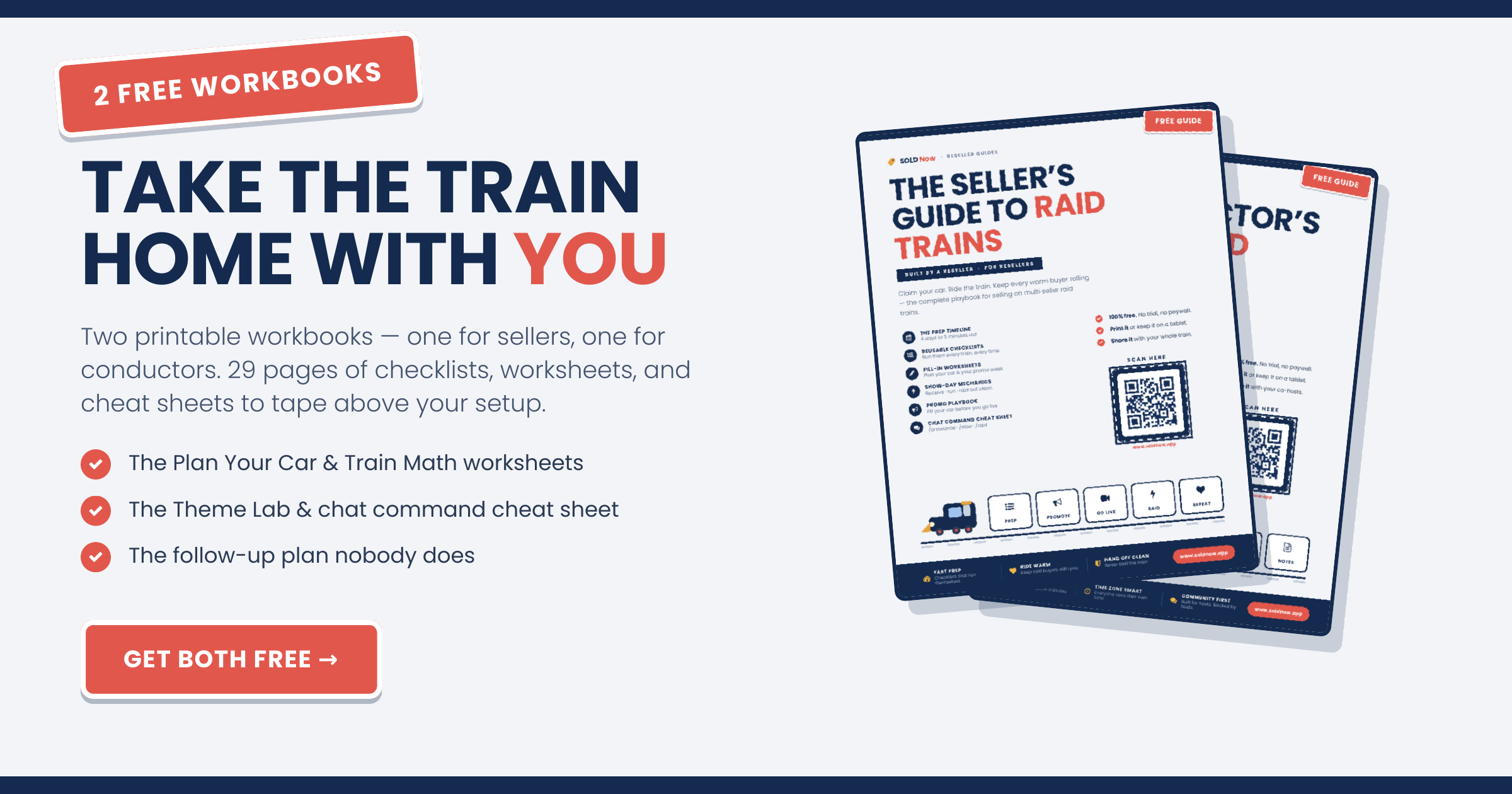
We turned all of this into two printable PDF workbooks — The Seller's Guide to Raid Trains and The Conductor's Guide to Raid Trains. Checklists you can tape above your setup, worksheets for planning your car (or your whole train), the theme lab, the chat command cheat sheet, and the follow-up plan.
Get both workbooks
Enter your name and email and both downloads unlock right here.
Your workbooks are ready.
Print them, or keep them on a tablet next to your setup. And share them with your whole train.
No spam, and no catch — we'd rather you use the free stuff than pay for something you don't need yet. That's kind of our whole deal.
You've got this!
— The SOLD Now team
Quick answers
What is a raid train on Whatnot?
A multi-seller live-selling event where sellers run shows back to back. Each seller claims a timed slot (a “car”), and at the end of it raids their audience to the next seller, so buyers ride from show to show all day.
How long does a raid train last?
Usually all day. Lineups often start around eighteen sellers and grow from there, with sellers taking fifteen- or thirty-minute cars. Car length × car count = total train length.
How do I join a raid train on Whatnot?
Be active in shows in your niche, ask conductors directly with your category and availability, read lineups in show notes — and check the Billboard in SOLD Now's free Raid Train Manager, where conductors list trains that need sellers.
Is the Raid Train Manager really free?
Yes — free on every SOLD Now plan, including Bronze, which is free forever.
What's the difference between a one-time raid train and a standing (weekly) raid train?
A one-time train is an event; a standing train runs on a schedule — same name, same day, every week or month. For sellers, a standing car becomes an appointment audience that compounds every run, and claiming it is a commitment to the whole lineup. For conductors, regulars keep their cars across the series so every date starts half-full — but expect constant churn, since somebody leaves almost every week. Build for it with a waitlist, a backup, and a signup tool that handles releases and swaps.